There's No Such Thing as a "Good Fade" — The Longest Wearer Always Wins
Fade Theory · 2026-06-22 · ~1,900 words · ~10 min read
Contents (7)
- Why Fading Happens — One Mechanism Worth Understanding
- Fabric Makers Read Character, Not Quality
- "Don't Wash for Six Months" — And Why You Can Ignore It
- Any Pair, Any Life — The Record Is Always There
- There Are Many Versions of Great
- One Pair, Worn Long
- Related Articles
There is no such thing as a "good" fade or a "bad" fade.
That might be a slightly uncomfortable thing to say in denimhead circles. The vocabulary around fading has become extraordinarily refined — vertical streaks (tate-ochi), whiskers at the hip crease, the honeycombing behind the knee. Forums dissect these features with the precision of a judging panel, and somewhere along the way the culture started to feel like a scored competition. A beautifully evolved pair earns praise; a pair that developed differently carries an unspoken apology with it.
But ask someone who works on the fabric side — a weaver, a dye technician, someone who has spent years watching cloth age — and the answer comes back flat and unhesitating: "We don't look for better or worse. We're reading the character of the fabric."
This isn't a dismissal of fading as unimportant. It's the opposite. The absence of a single correct answer means every fade is correct. Every pair is right. Every outcome is someone's singular, unrepeatable record. The moment you put down the scoring rubric, the jeans in front of you become instantly more interesting.
This piece explains the mechanics behind why fades form the way they do, clears up the most persistent piece of received wisdom (the no-wash rule), and lands on what is genuinely the simplest conclusion in denim: stop worrying, wear the jeans, wash them when they need it, and keep going for years. That's the whole thing.
Why Fading Happens — One Mechanism Worth Understanding
To understand why every fade is different, you need to understand one thing about how denim is dyed. It's called ring dyeing.
The warp yarns — the vertical threads that give denim its structure — are dyed with indigo in a way that deposits pigment only on the outer layers of each yarn. The core of every thread stays white. If you could slice a dyed warp yarn crosswise, you'd see it like a tree ring or a jawbreaker: blue on the outside, white at the center. This is why the method is called ring dyeing.
The implication is straightforward. As you wear denim and fabric rubs against itself or against other surfaces, the blue outer layers gradually abrade away, and the white core begins to show through. Fading is not color disappearing — it is the blue shell wearing down to reveal the white that was always underneath. (The dyeing methods that produce this are covered in more detail in the types of indigo dyeing and ring dyeing.)
This is the foundation on which every other observation about fading rests. Cone Mills White Oak — before its 2017 closure the last major American selvedge denim producer — built its reputation on this same principle. Levi's 501s in raw denim fade by exactly this mechanism. The classic Wrangler 13MWZ fades by it too. The process is universal; what changes is everything else.
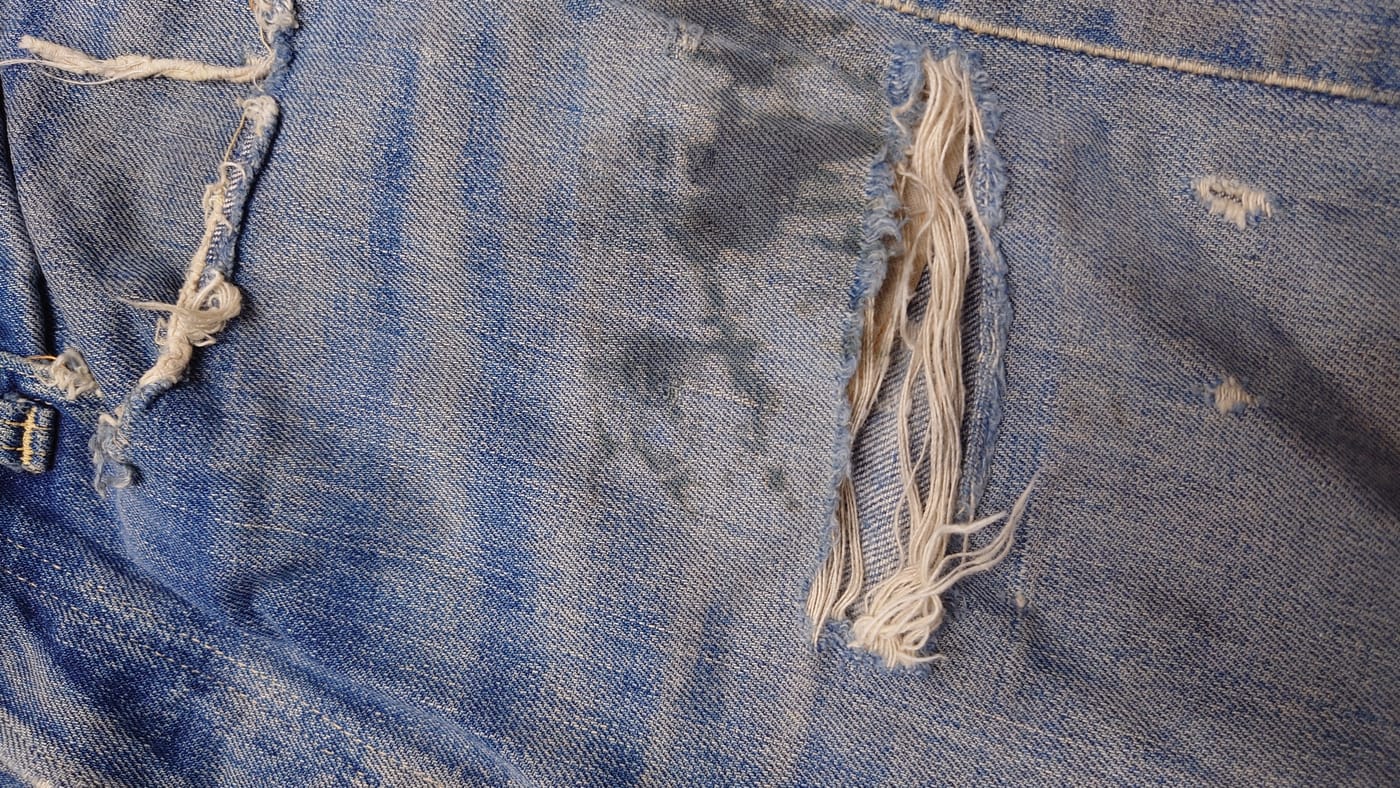
Look closely at any blown-out area of aged denim and you will see the white interior of the warp threads. The indigo was only ever on the surface. Fading is subtraction, not transformation. (Editorial photo)
Once you understand ring dyeing, the geography of fading makes obvious sense. Fading concentrates wherever abrasion concentrates:
- Whiskers (hige): The hip crease folds and rubs every time you bend at the waist. The resulting radiating marks record the exact angle and depth of your particular stride and posture.
- Honeycombs (hachinosu): Fabric bunches and rubs behind the knee. The grid-like shadowing that develops is shaped by the specific way your knee bends and the fit of your particular cut.
- Strikes and hits (atari): Anywhere something presses against the fabric repeatedly — a wallet pocket, a key clip, the edge of a workbench, the seat of a chair — gradually lightens as the blue shell abrades.
(The formation mechanics behind these are covered in why whiskers and honeycombs form and the topography of friction on denim.)
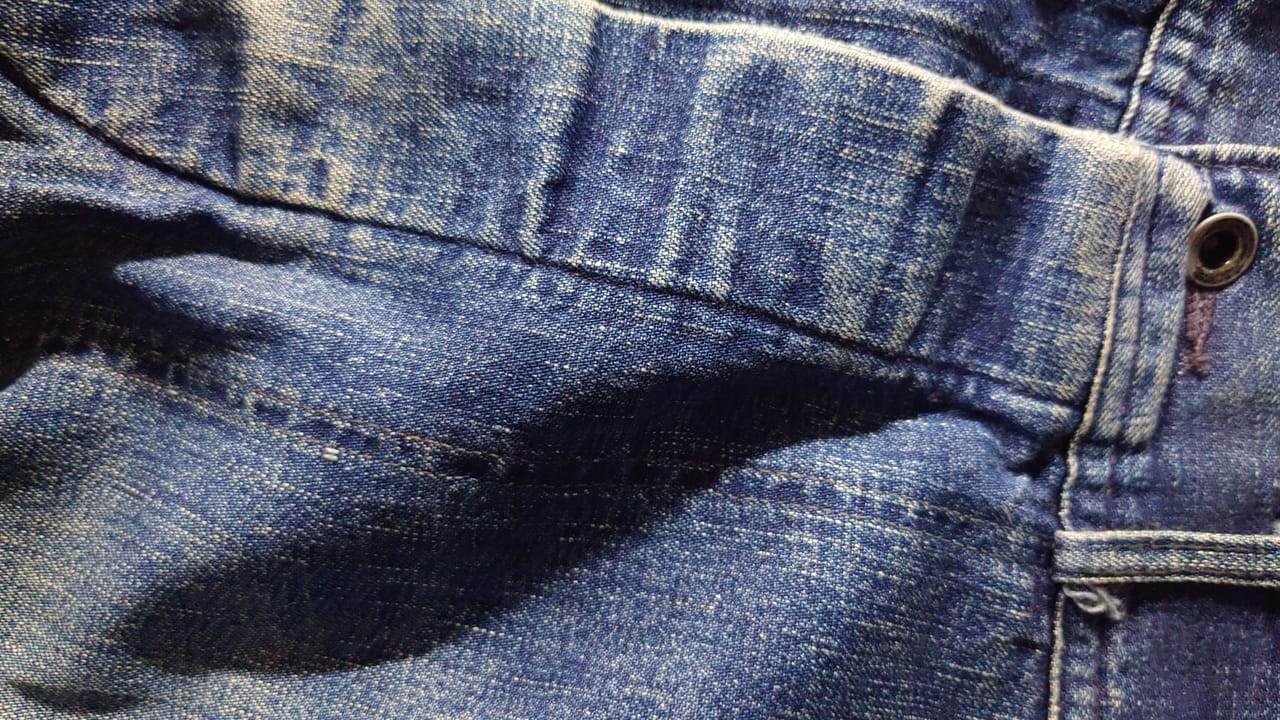
The contrast between abraded and unabraded areas is a direct record of movement. There is no way to fake this, and no way to replicate someone else's. (Editorial photo)
Fabric Makers Read Character, Not Quality
Layered on top of the ring-dyeing mechanism is the character of the cloth itself — and this is where things get genuinely interesting.
Not all denim is woven the same way. Yarn weight, fiber length, twist rate, and loom type all affect the surface texture of the finished fabric, and that texture determines how the indigo shell wears away. A yarn with intentional thickness variation — called slub yarn — creates a fabric surface with microscopic ridges and valleys. The ridges make contact first, abrade first, and lighten first. The valleys stay darker longer. The result is the high-contrast streaky fade associated with certain selvedge fabrics, often described as tate-ochi or vertical fade.
A more uniform yarn, woven on a modern projectile loom at high tension, produces a denser, smoother surface. Fades tend to develop more evenly, with less dramatic streaking and a softer overall gradient. Neither outcome is better. They are different expressions of different fabric philosophies.
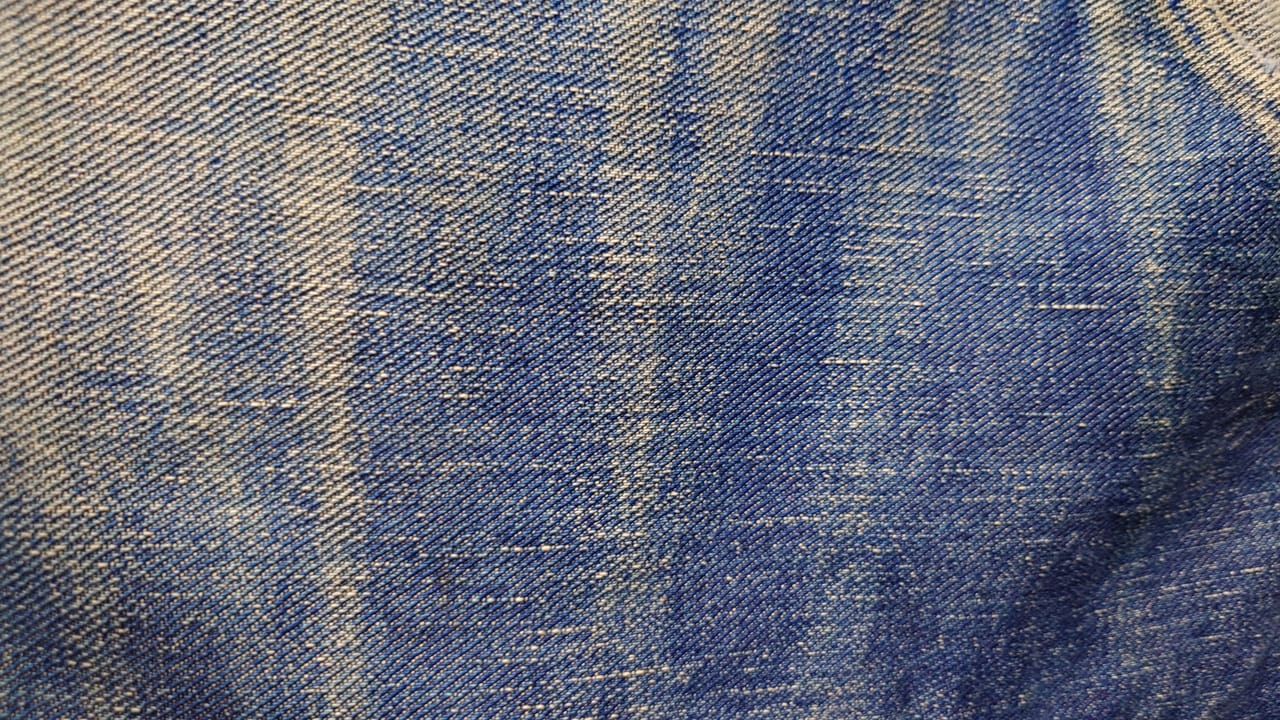
Slub yarn creates raised ridges that abrade ahead of the valleys, producing the streaky vertical fade many collectors prize. This is a designed property of the cloth, not a technique of the wearer. (Editorial photo)
Levi's understood this implicitly when they specified certain fabric constructions for different eras of their product. The rope-dyed ring-spun denim used in pre-1980s Levi's 501s produced dramatically different aging behavior from the open-width-dyed fabric that replaced it after production efficiencies changed the supply chain. The nostalgia for vintage Levi's fades is, in large part, a nostalgia for a specific fabric construction — not for the wearer doing anything special.
The working formula, then, is this: fade = ring dyeing × your movement × the character of the cloth. All three variables are unique to you, your pair, and your life. The combination has never existed before and will never exist again. Scoring it against someone else's pair is a category error.
"Don't Wash for Six Months" — And Why You Can Ignore It
No piece of denim folklore has more staying power than the no-wash rule. The idea is that withholding washing preserves the indigo and allows high-contrast creases to set in, producing dramatic whiskers and honeycombs rather than a flat, even fade.
The experienced answer to this is: if your jeans are dirty, wash them.
Fading is determined by wearing time, not by washing abstinence. A pair worn for two years with regular washes will show more fade than a pair worn for six months without a single wash — because more total hours of wear means more total abrasion, full stop. The no-wash rule optimizes for crease contrast at the cost of everything else, including the integrity of the fiber itself. Salt from sweat and accumulated body oil degrade cotton over time. The jeans you refused to wash for six months may look dramatic in the short term and fall apart earlier in the long term.
The sensible framework, which requires no sacrifice and no special discipline:
- Wear the jeans you actually like. Brand, price point, and ounce weight are the starting conditions, not the outcome.
- Wear them in your actual life. Commuting, working, sitting, walking. Fading is a record of habitual movement — a jeans-specific life lived deliberately is no different from a normal life, just noticed more carefully.
- Wash when dirty. Inside out, cold water, gentle cycle, hang dry in shade. That's it for most pairs.
- Skip optical brighteners and fabric softener. Brighteners shift the color toward an artificial blue-white; softener coats fibers in a way that mutes the friction-driven abrasion that creates contrast. Everything else in your laundry routine is probably fine.
The longer version of washing guidance — detergent selection, soaking vs. machine washing, dealing with starch — is laid out in the washing-frequency guide. The point here is simpler: the intimidation around denim care is mostly unnecessary. Clean jeans fade. Worn jeans fade. The only jeans that don't fade are the ones sitting in a drawer.
Any Pair, Any Life — The Record Is Always There
With the mechanics in place, the central claim of this piece becomes easy to support.
Wear any jeans consistently, in your actual life, and your life will write itself into the fabric.
A carpenter's pair will carry the arc of a hammer grip in the right thigh, the knee-drop pattern from working on floors, the tool-belt pressure marks on the waistband. A cyclist's pair will concentrate fading at the inner thigh and the saddle contact point. An office worker's pair will develop a different distribution — sitting pressure at the seat and thighs, the wallet outline, the phone pocket edge.
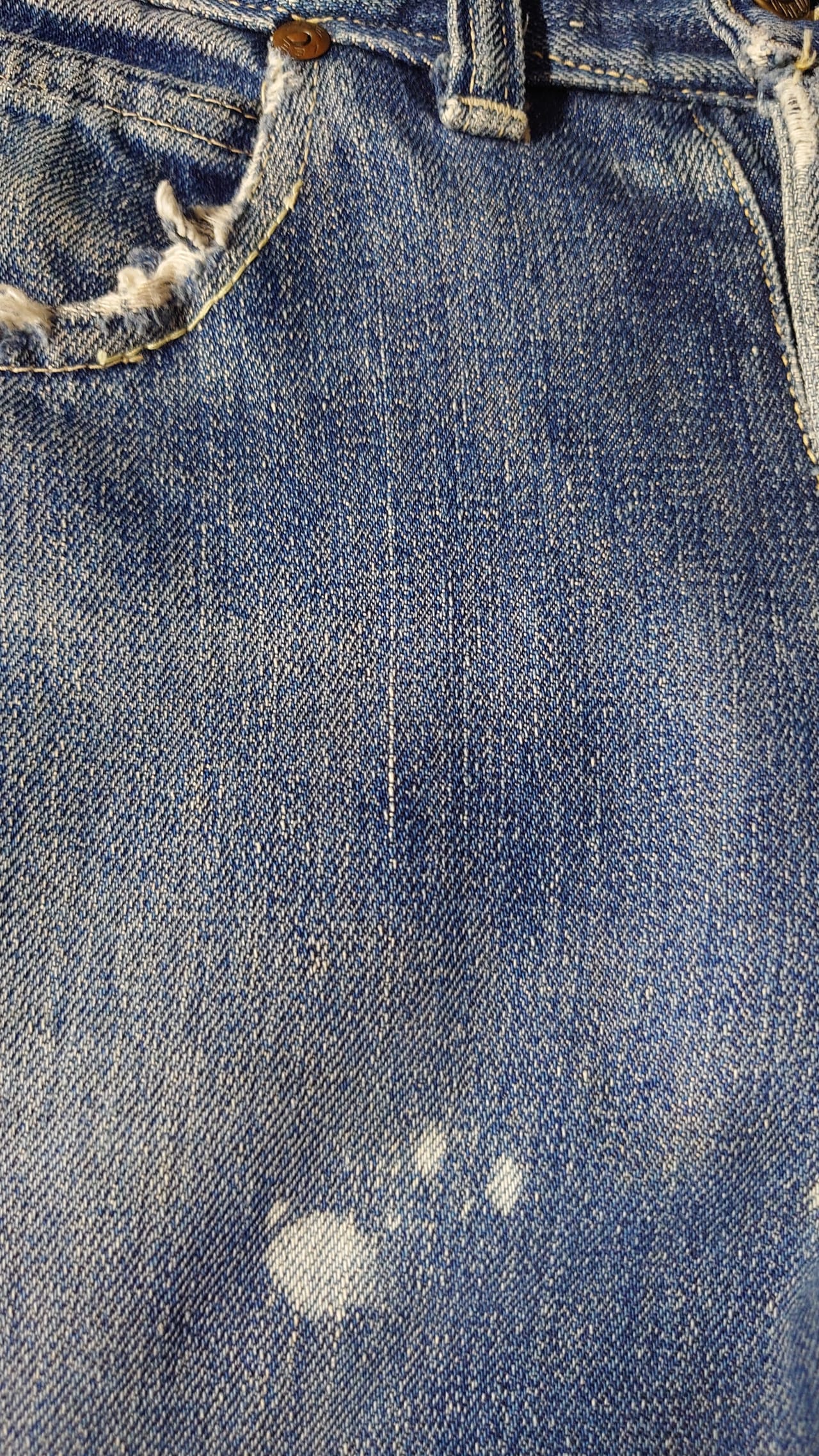
Paint splatter, oil stains, a frayed pocket edge — these are not flaws. They are dated entries in a wearable log. No one else can replicate them, and no one has standing to tell you they're wrong. (Editorial photo)
None of this requires expensive fabric. Levi's 501s in rigid denim will record your life as faithfully as any selvedge pair at five times the price. (If you want to follow the process of breaking in a raw pair from scratch, see growing a raw denim fade.) The fabric character will differ — the fade gradient will look different, the texture will be different — but the biographical function is identical. You wore them. They show it. That is the whole point.
The LVC (Levi's Vintage Clothing) line exists largely to recreate the fabric conditions of early Levi's so that modern wearers can produce fades closer to the vintage aesthetic. That's a legitimate and beautiful project. But it is not the only legitimate project. A pair of current-production 501s worn daily for three years is also a legitimate and beautiful project. A pair of Lee 101s in medium-weight denim worn for five years is a legitimate and beautiful project. The fabric is the starting material; the wearer is the author.
There Are Many Versions of Great
Just as there is no correct fade, there is no correct aesthetic preference.
Some people are drawn to high-contrast vertical streaking on dark indigo — the sharp, almost graphic quality of a well-worn selvedge pair at the one-year mark. Others prefer the soft, bleached-sky blue of denim that has been worn and washed for a decade into uniform lightness. Some find the sharp crease marks of an unwashed break-in period compelling; others find gently gradated washes more wearable. All of these are coherent positions. None of them is wrong.
The denim community at its best has always been generous with this. The subreddits dedicated to raw denim generally celebrate any pair with genuine wear — a $40 pair of Levi's ridden hard for three years gets as much genuine enthusiasm as a premium selvedge pair. That generosity is not naivety. It reflects an accurate understanding of what fading actually is: the outcome of someone's time, not a purchasing decision.
At its worst, the community can turn evaluative in ways that feel exclusionary — grading whiskers, dismissing certain brands as unworthy of serious attention. That posture misunderstands the mechanics. The indigo doesn't know the price of the jeans. The fiber doesn't care what the label says. The fabric records time, and time is democratic.
One Pair, Worn Long
Fading has no correct answer. What it has is a mechanism — ring dyeing — a material with its own character, and a person who wears it over time.
The conclusion that follows is genuinely simple: pick a pair you like, wear it in your actual life, wash it when it needs washing, and keep going for years. The rest takes care of itself.
Some people reach a point where they can spend an hour talking about a single pair's fade history — tracking the development of a particular knee crease, remembering the trip where the wallet pocket lightened — and that is a completely wonderful place to be. But the path there does not require buying the right brand, following a no-wash protocol, or developing a connoisseur's vocabulary before you start. It requires one pair and time.
The fade that comes out the other side belongs to no one but you. No one made it for you. No one can replicate it. And no one with a scoring system has any standing to tell you it isn't exactly right.
Denim fading has no hierarchy. It has only the time you put in.
This article draws on publicly available information about textile dyeing, yarn construction, and weaving, combined with editorial observation of worn denim samples. Fading outcomes vary significantly based on fiber composition, fabric weight, body type, wearing frequency, washing habits, and daily activity. Descriptions of fading tendencies represent likely patterns rather than guaranteed results for any specific product.
Sources & References
- Tortora, P. G., & Johnson, I. (2014). The Fairchild Books Dictionary of Textiles (8th ed.). Fairchild Books. — Ring dyeing and yarn construction terminology.
- Sullivan, J. (2006). Jeans: A Cultural History of an American Icon. Gotham Books. — Historical context of Levi's fabric specifications and production transitions.
- Marsh, G., & Trynka, P. (2002). Denim: From Cowboys to Catwalk. Aurum Press. — Overview of indigo dyeing and selvedge weaving traditions.
- Cone Mills White Oak historical production records and public archives (via denim trade press, 2010–2017).
- r/rawdenim community fade documentation threads (ongoing); used as observational reference for fade pattern variety across price points and brands.
Share this article
Related Articles
- Fade TheoryWhat One Year of Raw Denim Wear Actually Produces — Whiskers, Honeycombs & Rivet Stars ExplainedA phase-by-phase analysis of the standard 12-month raw denim base fade arc — covering whisker mechan…
- Fade TheoryRaw Denim at 30 Days — The Early Fade Signals You're Looking For (And Why They Matter)After 30 days of wear, the first whisker geometry and knee rise are already forming — subtle but str…
- Fade TheoryNatural vs Synthetic Indigo in Denim — How Dye Source Shapes the FadeNatural and synthetic indigo share the same chemical formula, yet differ fundamentally in purity, hu…
- Fade TheoryDoes Washing Accelerate Denim Fading? — Untangling the Science of Wash Frequency & Indigo LossEvery wash, your raw denim looks a shade lighter. But is the machine actually creating that fade — o…
- Fade TheoryTate-Ochi Explained — Why Vintage Denim Fades in Vertical StreaksVertical fading lines on worn denim aren't random — they're written into the yarn before the fabric …
Go Deeper
This article's argument — that there's no single correct fade — is easiest to see across a wide range of real, worn pairs, which is exactly what this book documents.
📖 Find it on Amazon
As an Amazon Associate we earn from qualifying purchases.
Related Articles
Articles in the same category:
- Denim Honeycomb Fade Explained: 3-Stage Formation Process & 4 Tips to Deepen the Crease Pattern
- Denim Atari Fade Patterns Explained: Tate-Ochi, Yoko-Ochi, Dan-Ochi & Marble — 4 Types Compared
- How Often Should You Wash Raw Denim — The Monthly / 3-Month / 6-Month / Never Debate
- How to Choose the Right Detergent for Raw Denim — Neutral, Mild-Alkaline & Specialist Options
Go Deeper — Books and Films
A few books and films that sit alongside this article — denim and American culture, read and watched.
- Rebel Without a Cause (1955)
James Dean made denim the uniform of teenage rebellion. The starting point for everything that came after. - The Wild One (1953)
Marlon Brando and the motorcycle jacket. The film that built the biker-and-denim archetype. - Easy Rider (1969)
The American New Cinema landmark. Freedom, the open road, and denim as a way of life.
This site uses affiliate links. Purchases made through these links support NJNL at no extra cost to you.