Why Fades Always Appear in the Same Places — The Topography of Friction on Denim
The Science of Fade · 2026-06-02 · ~1,800 words · ~8 min read
Contents (6)
- The Short Answer — Fades Follow the Terrain of Friction and Load
- What a Fade Mark Actually Is — Indigo Structure and Abrasion
- The Zones: Where Friction Topography Is Structurally Inevitable
- What Shifts the Map — Individual Variables
- The Bigger Picture — A Map of One Person's Life
- Related Articles
Pull a well-worn pair of raw denim out of the closet and the story is written right there on the fabric: a bright crease behind each knee, a fan of lighter lines radiating out from the crotch, a faint rectangular ghost on the back right pocket where a wallet used to live. These marks didn't appear randomly. They show up in roughly the same places on every pair of raws, worn by every person who puts in serious time with them. The question worth asking is why — and the answer lies less in the denim itself than in the mechanical reality of a human body in motion.
This article works through the physics: where friction and load concentrate on a pair of jeans, why those zones are structurally inevitable, and what variables shift the exact map from wearer to wearer.
The Short Answer — Fades Follow the Terrain of Friction and Load
Fade on raw denim isn't random degradation. It's a record of where fabric bends, presses, and rubs — repeatedly, predictably, over hundreds of wears. The reason the same zones light up on virtually every pair of earnestly worn raws comes down to one simple fact: human bodies move in consistent patterns.
Sit down, stand up, walk, crouch. Every time you do any of those things, you're folding the fabric at the same crease lines, pressing it against the same surfaces, loading it with the same weights. Over time, those repeated mechanical events etch a topographic map into the cloth — valleys where creases deepen, ridges where fabric stretches tight, pressure points where objects push from inside the pocket. That map is what we call fade.
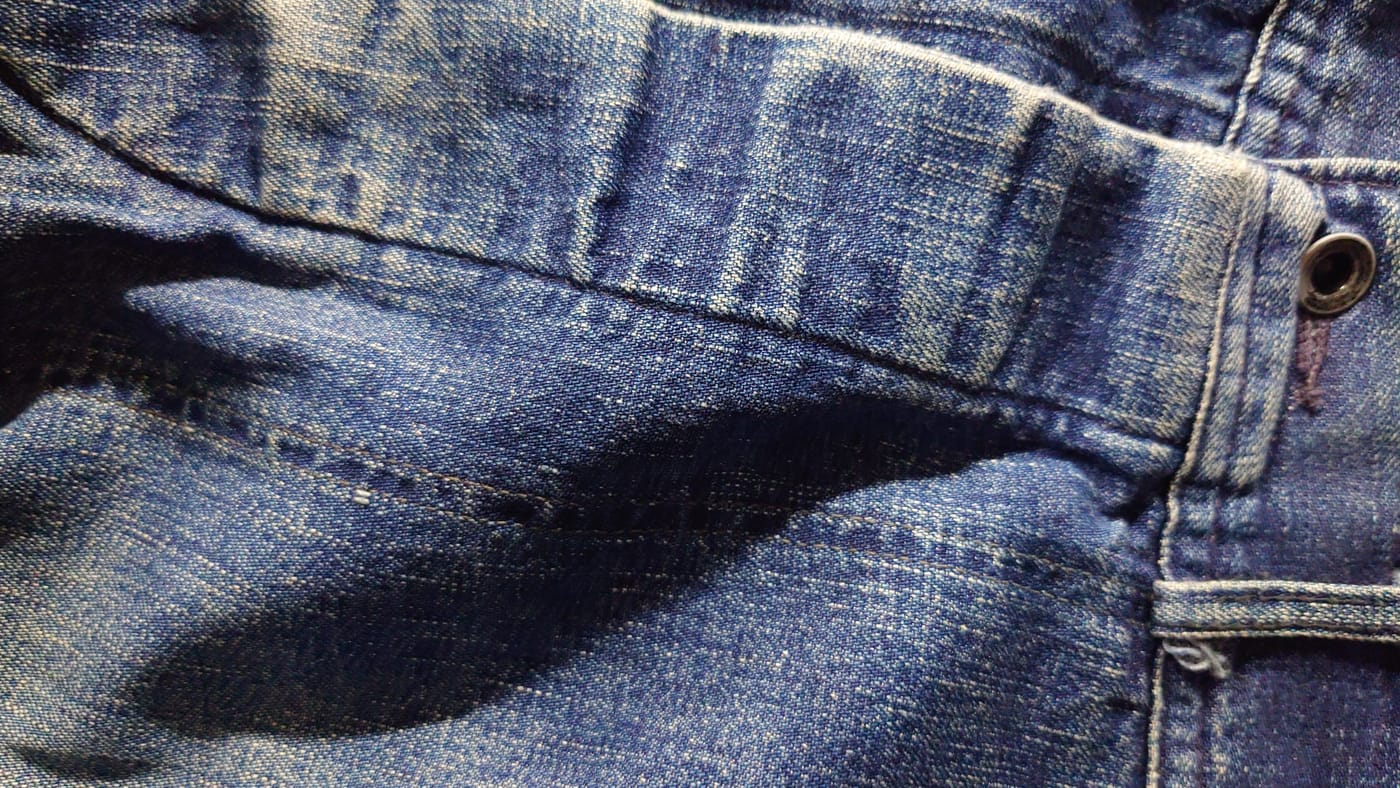
A pair from our own collection. Only the zone where the fabric repeatedly folds and rubs has gone bright, standing out sharply against the darker field around it. This is the "friction concentrated in a specific zone" of the section above, made visible on real cloth. (Editorial photo)
The reason it shows up as visible contrast — bright lines against a darker field — has everything to do with how denim is dyed in the first place.
What a Fade Mark Actually Is — Indigo Structure and Abrasion
To understand why friction produces a visible bright line, you need to understand how indigo sits on a yarn. Selvedge and quality raw denim is typically dyed using a rope-dyeing process — the yarn bundle is dipped repeatedly in indigo vats and oxidized between each dip. The result is a yarn that carries indigo heavily on its outer surface while the cotton core remains largely undyed white. This structure is sometimes called tate-ochi in JP enthusiast circles, or more descriptively, the "white core" construction.
When the surface of the fabric abrades — through repeated bending, rubbing against a chair, friction from adjacent fabric — those outer indigo molecules are the first to depart. The white cotton core underneath begins to show through. Do that ten thousand times in the same location and you get a bright, high-contrast mark against the surrounding darker field that hasn't seen the same intensity of friction.
This is why Levi's vintage pairs — proper cone mills selvedge-era 501s and their descendants — develop such dramatic fade contrast. The combination of ring-spun yarn, rope-dyed indigo, and relatively tight weave creates a fabric where surface indigo is dense but also positioned right at the friction interface. Wash the pair, and loosened indigo rinses away, locking the contrast in place a little more permanently.
Two conditions have to combine to produce a proper fade mark: (1) a dye structure that concentrates indigo at the surface, and (2) a mechanical event — repeated friction or pressure — concentrated in a specific zone. Remove either condition and the mark doesn't form with the same definition.
The Zones: Where Friction Topography Is Structurally Inevitable
Behind the Knee — The Deepest Fold
The back of the knee is the single most reliable fade zone on any earnestly worn pair of raws. When you sit down, the fabric at the back of the knee folds sharply and repeatedly. The apex of that fold — the outermost edge of the crease — is simultaneously stretching the fabric tight and rubbing fabric-on-fabric with every micro-movement of the seated leg.
From a textile mechanics standpoint, the explanation is straightforward: at the apex of any sharp fold, fiber crimps outward and presents more surface area to adjacent fabric and surfaces. The contact pressure at that apex is higher than on flat sections of the cloth. Repeat this thousands of times across the working life of a pair of jeans and a honeycomb pattern — called hachi-no-su in the JP enthusiast lexicon, literally "beehive" — emerges as a tight grid of bright creases.
The depth and definition of the honeycomb depends on how sharply the wearer folds that crease (fit, sitting posture, chair height), how often they sit versus stand, and critically, whether they allow the crease to set by wearing the jeans for extended sessions before washing. A wearer who washes every two weeks will have a softer honeycomb than one who goes six months between washes — the latter's crease has had time to set into the fiber structure before the loose surface indigo rinses away.
The Crotch and Upper Thigh — Whiskers and Walk Lines
The radiating fan of bright lines that spreads from the crotch point — called hige (whiskers) in JP denim culture, and visible on virtually every significant Levi's archive or LVC reproduction — forms through a slightly different mechanism. The crotch seam is the convergence point of four fabric panels under constant tension while standing and walking. When you take a step, those panels pull against each other. When you sit, the fabric at the inner thigh bunches and creases in the direction of that tension.
The lines aren't arbitrary — they follow the angle of tension that the specific cut of the trouser imposes on the body. A slim straight cut like the classic 501 geometry creates different whisker angles than a high-rise, wide-thigh cut. Wrangler's cowboy-cut geometry, optimized for mounted wear, produces different tension vectors than a Levi's regular taper. The whisker pattern is, in part, a record of the pattern's geometry interacting with the wearer's particular stance and hip structure.
Pressure Points — The Wallet Outline and Object Ghosts
The back pocket ghost is perhaps the most legible form of fade for non-enthusiasts: the faint rectangular outline of a wallet pressed against fabric from inside, over hundreds of sits on hard surfaces. This is a compression fade rather than a bending fade. The wallet acts as a rigid substrate that presses the fabric against whatever the wearer is sitting on, concentrating friction at the wallet's perimeter.
The same mechanism produces key outlines, phone ghosts (increasingly common as back-pocket phone carrying became standard), and coin pocket wear marks. Old-school denim hunters who work vintage markets talk about reading the "back pocket story" of a found pair — which side the wallet was on, how thick it was, whether the owner carried coins. It's not a precise forensic science, but the broad strokes of a person's carry habits do leave a readable trace in the fabric.
What Shifts the Map — Individual Variables
The zones described above are tendencies, not certainties. The same model of jeans, worn by two different people, will produce recognizably similar fade geography but meaningfully different local detail. Several variables drive that divergence.
Fit and body geometry: A pair worn with significant ease in the thigh will crease differently than the same size worn as a slim fit. The former distributes fabric loosely and may produce softer, broader fade zones; the latter concentrates tension and produces sharper, more defined crease marks. Inseam length affects where exactly the knee crease falls relative to the fabric — a pair hemmed too long will create a secondary crease above the knee that a properly hemmed pair won't.
Occupation and movement pattern: A warehouse worker who squats and lifts repeatedly will develop different fade geography than an office worker who sits at a desk for eight hours. The former loads the knee and hip zones through dynamic flexion; the latter loads the back pocket and waistband zones through static compression. Cyclists, famously, develop distinctive inner-thigh fade from the repetitive pedaling stroke. Tradespeople who kneel frequently often show pronounced knee-cap abrasion that desk workers never develop.
Wash timing and method: This is the variable with the most contested received wisdom in the raw denim community. The general principle is that washing removes loosened surface indigo, and doing so while a crease is strongly set (versus soft and unfixed) produces crisper, higher-contrast fade lines. Washing too frequently before creases have set tends to produce even, gradual color reduction without dramatic topographic contrast. Washing infrequently allows crease structures to harden — which can produce striking results but also stresses the fabric at fold points.
None of this is deterministic. Fade is an emergent property of dozens of variables interacting simultaneously, many of which shift day-to-day. The same wearer, sitting in a different chair, will load the back-of-knee crease slightly differently. That variability is part of what makes the final result of a long wear genuinely individual.
The Bigger Picture — A Map of One Person's Life
The denim enthusiast community's attachment to fade isn't purely aesthetic — it's that a well-worn pair of raws is a physical document. The topography of the fabric encodes the wearer's build, their habits, the kind of work they did, the things they carried, the way they moved. Two pairs of nominally identical jeans, worn by two different people for the same number of hours, will not look the same. The fabric records the individual, not the model.
That one-to-one relationship between wearer and garment is what separates raw denim fade from the artificial distressing applied at the factory — the sandblasting, laser etching, and targeted abrasion that major denim manufacturers use to simulate the look of a worn pair before the first wear. Those processes produce a statistical average of what worn jeans tend to look like. Raw denim fade produces a specific record of one person's specific life.
From a materials standpoint, the mechanism is straightforward: indigo concentrates at the yarn surface, friction removes it, load and bending patterns create consistent friction zones, and the wearer's individual variables shift where exactly those zones fall and how sharply they define. From the perspective of anyone who has actually worn a pair through to a real fade, that mechanism produces something that feels a lot more significant than the physics alone suggests.
Denim is a fabric science can explain — but science alone will never make two pairs look the same.
Sources & References
- Indigo rope-dyeing and yarn structure: general textile science references on ring-spun yarn construction and surface-dyeing properties of vat dyes
- Levi Strauss & Co. archival documentation on cone mills selvedge construction and 501 pattern geometry, various public releases
- Wrangler heritage pattern documentation, rodeo cut geometry references
- Levi's Vintage Clothing (LVC) product notes on rope-dyed selvedge reproduction methodology
- Denim enthusiast community wear reports and fade documentation (Superfuture, r/rawdenim archives)
- General textile abrasion mechanics: ASTM D3884 and related public-domain references on fabric wear at fold apexes
- Historical accounts of rope dyeing and "white core" construction in denim production, Denim: From Cowboys to Catwalks (Amy Leverton, 2014)
Share this article
Related Articles
- Fade TheoryWhat One Year of Raw Denim Wear Actually Produces — Whiskers, Honeycombs & Rivet Stars ExplainedA phase-by-phase analysis of the standard 12-month raw denim base fade arc — covering whisker mechan…
- Fade TheoryThere's No Such Thing as a “Good Fade” — The Longest Wearer Always WinsRing dyeing, fabric character, and the myth of washing abstinence: why denim fading has no right ans…
- Fade TheoryRaw Denim at 30 Days — The Early Fade Signals You're Looking For (And Why They Matter)After 30 days of wear, the first whisker geometry and knee rise are already forming — subtle but str…
- Fade TheoryNatural vs Synthetic Indigo in Denim — How Dye Source Shapes the FadeNatural and synthetic indigo share the same chemical formula, yet differ fundamentally in purity, hu…
- Fade TheoryDoes Washing Accelerate Denim Fading? — Untangling the Science of Wash Frequency & Indigo LossEvery wash, your raw denim looks a shade lighter. But is the machine actually creating that fade — o…
Go Deeper
For readers who want to see friction-zone fading documented across real, worn pairs, this is the standard reference on selvedge culture and fade.
📖 Find it on Amazon
As an Amazon Associate we earn from qualifying purchases.
Related Articles
Articles in the same category:
- Denim Honeycomb Fade Explained: 3-Stage Formation Process & 4 Tips to Deepen the Crease Pattern
- Denim Atari Fade Patterns Explained: Tate-Ochi, Yoko-Ochi, Dan-Ochi & Marble — 4 Types Compared
- How Often Should You Wash Raw Denim — The Monthly / 3-Month / 6-Month / Never Debate
- How to Choose the Right Detergent for Raw Denim — Neutral, Mild-Alkaline & Specialist Options
Go Deeper — Books and Films
A few books and films that sit alongside this article — denim and American culture, read and watched.
- Rebel Without a Cause (1955)
James Dean made denim the uniform of teenage rebellion. The starting point for everything that came after. - The Wild One (1953)
Marlon Brando and the motorcycle jacket. The film that built the biker-and-denim archetype. - Easy Rider (1969)
The American New Cinema landmark. Freedom, the open road, and denim as a way of life.
This site uses affiliate links. Purchases made through these links support NJNL at no extra cost to you.