Denim Whiskers Formation Explained: 3 Factors That Determine Pattern, Angle & Intensity
Fade Theory · 2026-05-09 · ~1,500 words · ~6 min read
Contents (4)
- The Physical Mechanism
- Three Variables That Determine Count and Angle
- Fabric Structure Effects
- A Three-Stage Timeline
Of all the fade patterns that develop on a pair of denim, none varies as much from person to person as whiskers. While honeycombs are governed by the relatively simple geometry of knee folding, whiskers form on top of the complex three-dimensional structure of the hip joint. Even when the same pair of jeans is worn by different people, the count, density, and angle of those radial lines diverge sharply. This article systematically examines the variables that produce that divergence.
The Physical Mechanism
Whiskers are high-position abrasion lines that emerge on the front of the upper thigh as the hip joint is repeatedly flexed and extended. In ordinary daily motion — standing, sitting, walking — the fabric over the front thigh is alternately compressed and stretched around the hip joint as a pivot. The repeated stress accelerates the loss of indigo dye along the ridges of the resulting folds, producing visible lines of whitening.
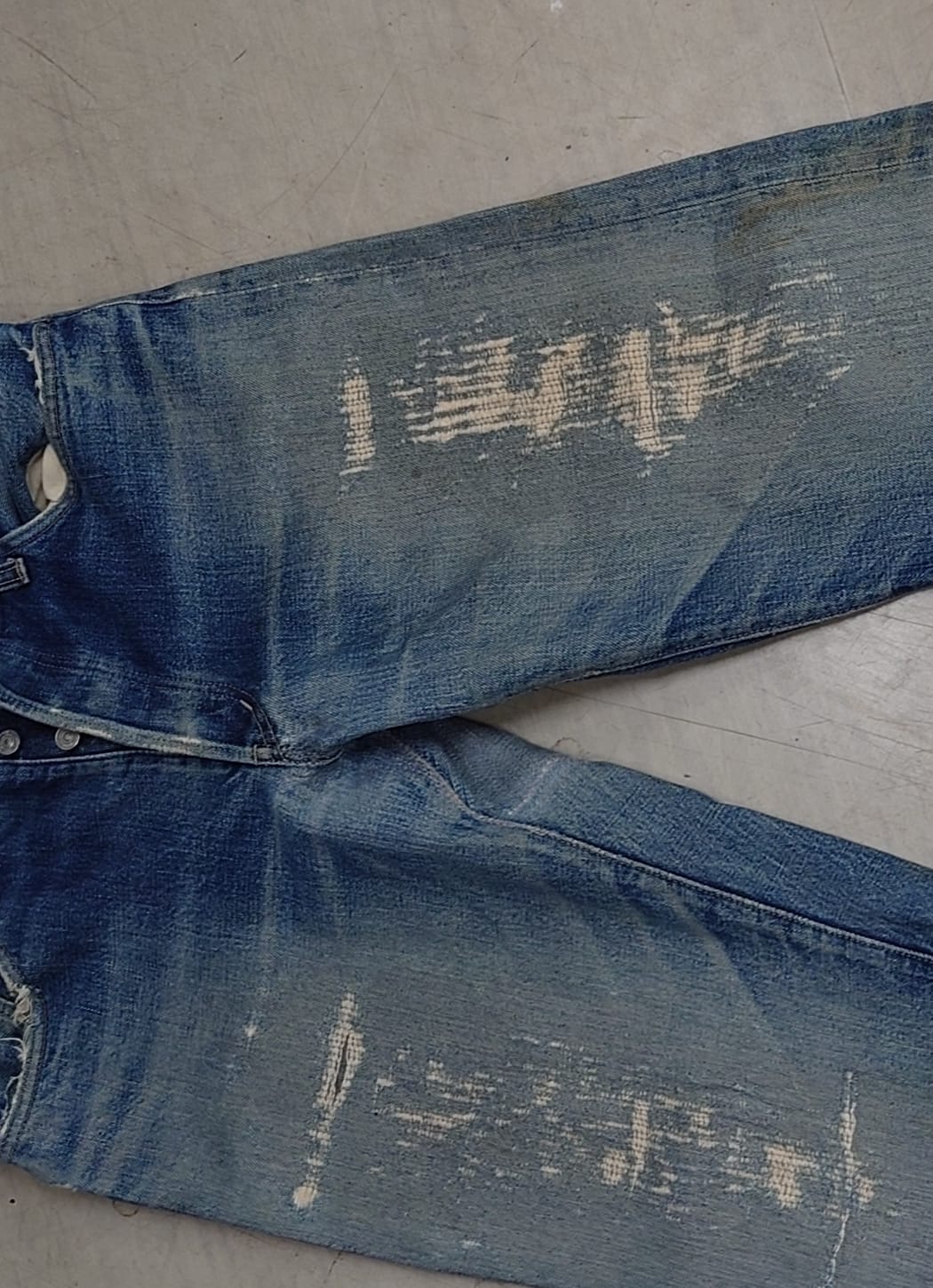
The front thigh of a pair our editor wore for several years. The fold ridges that form around the hip joint have abraded all the way down to the white core of the yarn. This is what whiskers look like once that "only the ridge whitens" property is pushed to its extreme — the lines eventually grow into broad fields of white-out. (Real pair, photographed by the editor.)
The structure of indigo dyeing makes this possible. Indigo does not form covalent bonds with the cotton fiber; it physically adsorbs onto the surface of the yarn. When mechanical energy concentrates at the surface — through friction or compression — the dye separates relatively easily. Where a whisker forms, the fabric "ridge" stays under tension and exposes more surface area, while the adjacent "valley" stays folded inward and sees little wear. This microscopic alternation of ridge and valley is what gets visualized as a line.
Denim is a warp-faced twill: warp tension is high, but bias-direction deformation is comparatively easy. The fabric near the hip joint is pulled in compound directions that include a bias component, which is why whisker lines almost always run on a diagonal — neither pure warp nor pure weft.
It's worth dwelling on that diagonal for a moment, because it explains a lot of the variation people notice. A crease that ran perfectly horizontally would mean the fabric was folding along a pure weft line; a vertical one would mean a pure warp fold. Neither happens cleanly at the hip, because the joint doesn't move in a single plane — flexion, slight rotation, and the pull of the seam all combine. The fabric resolves those competing forces by folding along the path of least resistance, which lands somewhere on the bias. The exact angle each line settles into is therefore a fairly direct readout of how a particular person's hip loads the cloth, which is part of why no two sets of whiskers are quite alike even on the same cut. Where the lines sit, how steeply they rake, and whether they fan or converge are all downstream of that compound motion rather than of anything the wearer does deliberately.
Three Variables That Determine Count and Angle
Rise Position
How high you wear your jeans on the hip directly determines where the whiskers originate. With a low rise, the rotational axis of the hip joint sits close to the crotch of the jeans, and most flexion-driven deformation concentrates in a small zone. The result tends to be fewer but darker lines, running at relatively sharp angles.
Conversely, when worn closer to the natural waist, the waistband anchors against the iliac crest, and hip flexion stretches the fabric across a broader region. The deformation energy disperses, and the lines spread out into a wider fan of finer whiskers. The delicate multi-line whiskers seen on vintage high-rise silhouettes are a product of this mechanical dispersion.
Sitting Habits
Even with the same rise, two wearers will get different whiskers depending on whether they sit mostly in chairs or on the floor (seiza, cross-legged). Chair-sitting holds the hip flexion angle at roughly 90 degrees, repeatedly reinforcing one direction of folding. The lines come out fewer in number but cut deeper.
When floor-sitting, deep squatting, or multi-directional flexion is part of daily life, the hip joint moves through varied angles. Without a single dominant deformation direction, the lines cross or scatter in angle. Internal/external rotation also asymmetrizes the inner and outer thigh wear, producing non-symmetric whiskers.
This is why occupation and lifestyle project so directly onto a pair of jeans. A desk-bound life tends to produce uniform lines; a physically varied job tends to produce complex patterns.
As an aside, one of us at NJNL once spent half a year photographing their own whiskers every week to compare them. Looking back over the set, the lines that formed on weekdays and the lines that formed on weekends had drifted into almost separate systems — which the person in question found more unsettling than satisfying. The lesson we took from it, more or less from the failure side, is that if you want a whisker pattern with real three-dimensionality, it may be worth consciously varying how you sit rather than locking into one posture. Take it as an anecdote rather than a rule; individual results vary a great deal.
Initial Fit (Tension)
The amount of tension on the fabric in the very first weeks is one of the decisive variables in how fast and how dark whiskers form.
If you start with a slightly tight fit, the fabric is already under static tension when you stand still. That initial tension increases the wear during each flexion cycle, and whiskers etch in early and dark. Because the fabric has nowhere to escape, line direction stabilizes quickly and the lines come out crisp.
A roomier fit means low static tension and fabric slack during flexion. The slack creates folds in multiple directions: more lines, but each one fainter. This style suits a longer, slower fade trajectory.
Whether the denim is raw (rigid) is another factor. With the starch still in, the fibers are stiff, and the folds formed in the first few hundred hours get "memorized" by the fabric. The postures and movements you do most during this memory phase essentially set the skeleton of your final whiskers.
Fabric Structure Effects
Yarn count and weave density matter too. Fine-count, high-density fabric has tightly interlocked yarns, so the height difference between fold ridges and valleys stays small — whisker contrast comes out softer. Coarse, lower-density fabric, common in casual denim, makes the folds stand up clearly and gives whiskers sharp edges.
Selvedge denim woven on shuttle looms, in particular, produces fabric with even weft tension and minimal surface variance. Whiskers on shuttle-loom selvedge tend to come out as relatively orderly lines — a function of the slow, low-tension weaving that contributes to the fabric's overall uniformity.
There is one more variable worth flagging if contrast is what you're after: indigo depth. Denim dyed through more dip cycles than a standard spec starts out closer to a deep, near-black blue, which widens the gap between the dyed background and the whitened areas where friction has lifted the surface dye. Some Japanese mills market this kind of heavily over-dyed fabric explicitly — the deeper the starting shade, the more legible the eventual whisker contrast tends to be while the pair is still in its rigid or one-wash state. It isn't a guarantee of a "better" fade, but it does make the early stages of whisker formation easier to read, because the light-against-dark differential is simply larger to begin with. As always, dye depth interacts with yarn, weave, and how the pair is actually worn, so treat it as one input among several rather than a single lever.
A Three-Stage Timeline
Whisker formation is easier to think about in three stages.
| Stage | Approximate timing | What's happening |
|---|---|---|
| Initial fixation | First wear ~ tens of hours | Fold "memory" gets imprinted on the fabric |
| Darkening | Tens to hundreds of hours | Indigo loss progresses, lines become defined |
| Stabilization | Hundreds of hours and beyond | Angle and count are locked; depth deepens |
How much you maintain consistent posture and motion during the initial fixation stage strongly governs the eventual pattern. Once direction is set, further wear largely carves the existing skeleton deeper rather than redrawing it.
It helps to think of the three stages as recording, developing, and printing. In the fixation stage the fabric is recording where folds want to sit. In the darkening stage indigo loss along the fold ridges turns that recorded geometry into something visible — faint at first, then clearly defined. In the stabilization stage the angles and count stop changing and the remaining work is depth: the same ridges keep losing surface dye, so the existing lines deepen rather than multiply. This is why two people who own the pair for the same number of months can be at quite different points — not only because they wear them differently, but because their pairs may sit at different stages of the same sequence.
Wash timing matters for the same reason. Washing while starch is still in can reset the fold memory. The traditional practice of wearing raw denim for long stretches without washing has a practical basis: it extends the initial fixation stage as long as possible.
Whiskers are not random. They are the body, the habit, and the choices of the wearer transferred onto cloth. The same garment worn by someone else would etch different lines. That irreversibility and individuality is exactly what elevates worn-in denim above ordinary clothing.
Sources & References
- General principles of indigo adsorption and friction-based dye loss in cotton fibers
- Public industry knowledge on shuttle-loom selvedge denim and uniformity
- Observational reports from worn-denim enthusiast communities
- Tortora, P. G. & Merkel, R. S., Fairchild's Dictionary of Textiles, Fairchild Publications
Share this article
Related Articles
- Fade TheoryWhat One Year of Raw Denim Wear Actually Produces — Whiskers, Honeycombs & Rivet Stars ExplainedA phase-by-phase analysis of the standard 12-month raw denim base fade arc — covering whisker mechan…
- Fade TheoryThere's No Such Thing as a “Good Fade” — The Longest Wearer Always WinsRing dyeing, fabric character, and the myth of washing abstinence: why denim fading has no right ans…
- Fade TheoryRaw Denim at 30 Days — The Early Fade Signals You're Looking For (And Why They Matter)After 30 days of wear, the first whisker geometry and knee rise are already forming — subtle but str…
- Fade TheoryNatural vs Synthetic Indigo in Denim — How Dye Source Shapes the FadeNatural and synthetic indigo share the same chemical formula, yet differ fundamentally in purity, hu…
- Fade TheoryDoes Washing Accelerate Denim Fading? — Untangling the Science of Wash Frequency & Indigo LossEvery wash, your raw denim looks a shade lighter. But is the machine actually creating that fade — o…
Go Deeper
For readers who want to see whisker formation documented across real, worn pairs, this is the standard reference on selvedge culture and fade.
📖 Find it on Amazon
As an Amazon Associate we earn from qualifying purchases.
Related Articles
Articles in the same category:
- Denim Honeycomb Fade Explained: 3-Stage Formation Process & 4 Tips to Deepen the Crease Pattern
- Denim Atari Fade Patterns Explained: Tate-Ochi, Yoko-Ochi, Dan-Ochi & Marble — 4 Types Compared
- How Often Should You Wash Raw Denim — The Monthly / 3-Month / 6-Month / Never Debate
- How to Choose the Right Detergent for Raw Denim — Neutral, Mild-Alkaline & Specialist Options
Go Deeper — Books and Films
A few books and films that sit alongside this article — denim and American culture, read and watched.
- Rebel Without a Cause (1955)
James Dean made denim the uniform of teenage rebellion. The starting point for everything that came after. - The Wild One (1953)
Marlon Brando and the motorcycle jacket. The film that built the biker-and-denim archetype. - Easy Rider (1969)
The American New Cinema landmark. Freedom, the open road, and denim as a way of life.
This site uses affiliate links. Purchases made through these links support NJNL at no extra cost to you.