Denim Atari Fade Patterns Explained: Tate-Ochi, Yoko-Ochi, Dan-Ochi & Marble — 4 Types Compared
Fade Theory · 2026-05-09 · ~2,200 words · ~5 min read
Contents (7)
- What Atari Is
- Lineage 1 — Vertical Fade
- Lineage 2 — Horizontal Fade (Slubby Fade)
- Lineage 3 — Step Fade
- Lineage 4 — Marble Fade
- How They Combine
- Which One Is "Best"?
The word atari — a Japanese term loosely meaning "the strike" or "the contact mark" — covers what English-speaking denim culture calls fade. But the term is more precise than its translation. Where the English word fade tends to lump every variation together, the Japanese vocabulary developed a four-line typology because Japanese denim culture watches the cloth at higher resolution. This article reads each of the four against the underlying mechanics that produce it.
What Atari Is
In English-language denim writing, fade covers everything: honeycombs, whiskers, hip pocket outlines, knee atari, contrast lines, the lot. Japanese culture, partly because of its proximity to the production side of denim and partly because of cultural attention to surface texture, separated the phenomena early. Knee crease fading became honeycomb. Hip flexion lines became whiskers. Pocket outlines became pocket atari. Each of these has its own name because each is a different mechanism.
The umbrella term for all of these is atari — "the strike" — meaning the pattern left where friction has struck the fabric. Look at the fade map of any well-worn pair, and you can read both the wearer's body and the fabric's structure from the strikes alone.
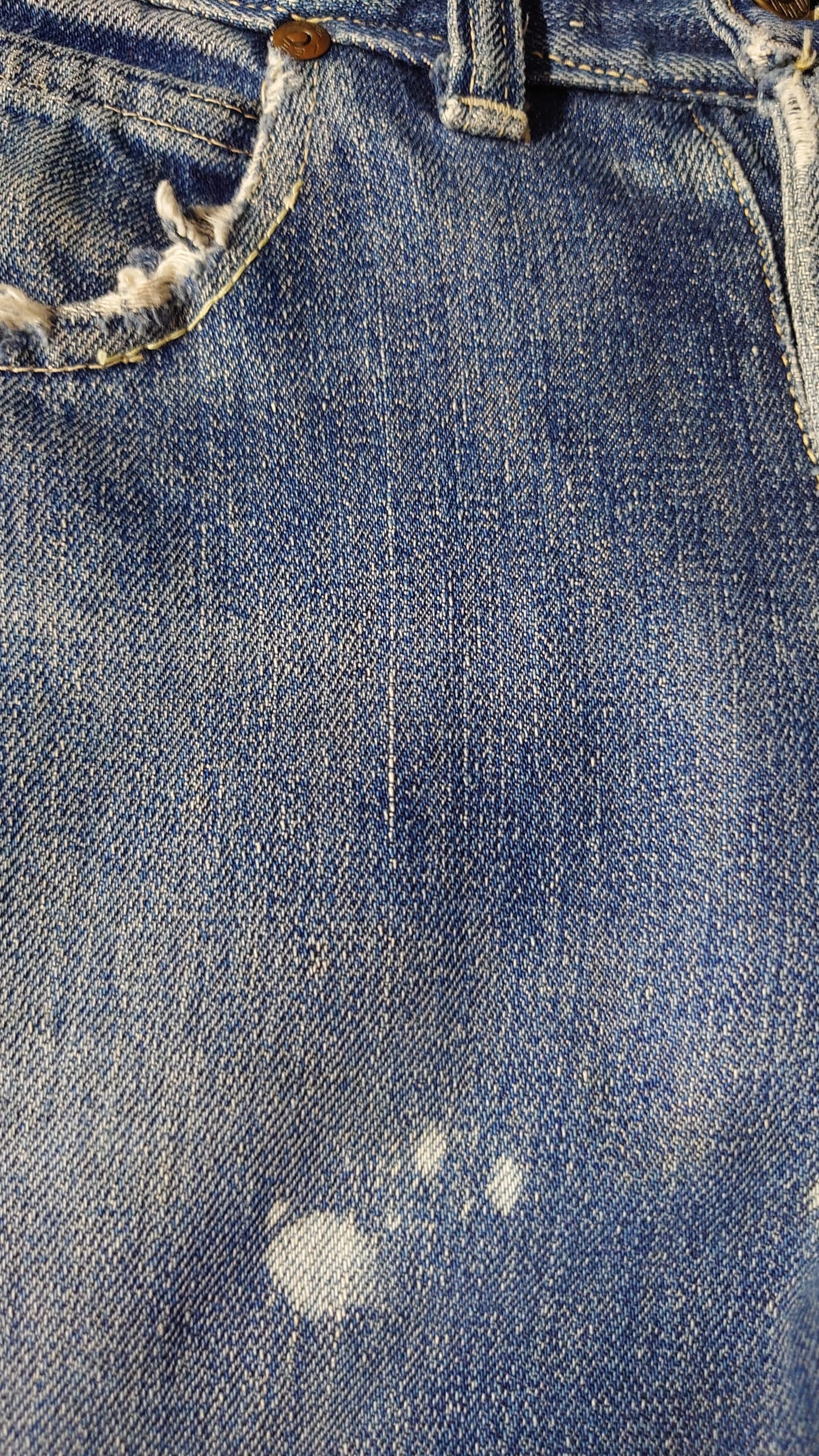
A pair from our own collection. Localized strikes trace the outline of the pocket mouth, while scattered white spots — bleach and paint — record the previous owner's daily use. The fade map and the stray marks together are exactly what gets "read" off a worn pair. (Editorial photo)
This piece narrows down to atari that runs across whole sections of fabric, rather than localized atari like honeycombs or whiskers, and groups them into four distinct lineages.
Lineage 1 — Vertical Fade
Vertical streaks of pale running down the front thighs and the front of the knee. Visually, this is what most people picture when they think of "Japanese denim fade."
- Mechanism: Rope dyeing produces yarn-by-yarn variation in dye penetration depth. As friction wears the surface down, individual warp yarns reveal their white cores at slightly different moments. Adjacent yarns going from blue to white at different rates — over hundreds of hours — turn into the lengthwise streaks you see.
- Common on: Rope-dyed × ring-spun × selvedge fabric — i.e., the standard high-quality Japanese-mill formula.
- Timeline: Faintly visible by month 6, fully developed by year 1–2.
Vertical fade is treated as the gold-standard fade in Japanese denim culture because its appearance simultaneously confirms the fabric's dyeing method (rope), the yarn structure (ring-spun, with deep core whiteness), and the loom (selvedge, with weft tension uniformity that doesn't mask the vertical lines). All three signal "premium" — and the fade reveals all three at once.
Lineage 2 — Horizontal Fade (Slubby Fade)
Where vertical fade runs lengthwise, horizontal fade runs across the fabric — wave-like ripples of light and dark moving roughly parallel to the weft.
- Mechanism: When the weft yarn has irregular thickness ("slubby" yarn), the thicker sections sit slightly higher on the fabric surface. They take more friction first and lose surface indigo first. The result is light-and-dark banding running across the warp direction.
- Common on: Fabric using deliberately irregular slub weft yarns. Many Japanese mills specialize in producing this look.
- Timeline: Slower than vertical — usually 2–3 years for full development.
Where vertical fade reveals the dye-and-yarn combination, horizontal fade reveals the yarn texture itself. Two pairs with the same weave but different weft yarns can produce noticeably different horizontal fade patterns.
Lineage 3 — Step Fade
Bright-and-dark steps running along seamlines, especially at the chain-stitched hem and the side seams.
- Mechanism: A chain stitch (the kind made on a Union Special–type machine) draws the fabric into a three-dimensional ripple along the seam. The high points of the ripple take more friction and lose surface indigo first. The low points keep their dye.
- Where it appears: Hem chain stitches, side seams, sometimes inseams.
- Timeline: Visible by year 1, more clearly pronounced by year 3.
Step fade is essentially evidence of the seamstress's work showing up on the cloth. Hems sewn on a single-needle machine fade much more uniformly; chain-stitched hems develop the characteristic stepped look. This is one reason connoisseurs notice (and value) chain stitching — it lays down an invisible layer of structure that becomes visible only with hundreds of hours of wear.
Lineage 4 — Marble Fade
Irregular, fluid, marble-like patterns of light and dark — no clear lines, no clear bands, just mottled cloth.
- Mechanism: A combination of irregular surface oxidation (humidity, temperature, sweat), uneven dye absorption from the start (often natural indigo or labor-intensive dyeing), and complex multi-directional motion that doesn't favor one wear direction.
- Where it appears: Naturally indigo-dyed denim, fabric made with a high degree of hand work, garments worn through unusually varied physical activity.
- Timeline: Often only visible after 5+ years of wear.
Marble fade is the hardest to control. You can't engineer for it with a particular fabric or wear pattern — it emerges from the interaction of factors that can't be standardized. The pairs of jeans most prized for marble fade tend to be those used in irregular ways by people who don't think about their denim at all.
How They Combine
Real pairs almost never show one lineage cleanly. The combinations carry their own meaning:
- Vertical + step — the canonical Japanese reproduction look. Selvedge fabric chain-stitched in the traditional Levi's-1947 specification will produce both, simultaneously, making a pair that visibly has both fabric and seam doing work.
- Horizontal + marble — a hand-made aesthetic. Slubby weft yarn combined with irregular wear produces texture-on-texture.
- Vertical only — usually high-volume rope-dyed denim from a non-selvedge loom. Sharp but uniform; the cloth gives nothing back.
- Step fade only — a tell-tale of fabric that wasn't built for vertical fade (no selvedge, OE-spun, slasher-dyed) but with quality chain-stitched seams. The seams do most of the visual work.
Read this way, the fade pattern on a pair of jeans is its structural signature: a complete description of yarn type, dyeing method, weave structure, and seam construction, projected onto a 2D map by months of wear.
Which One Is "Best"?
A matter of taste, with some structure.
- Japanese vintage-reproduction collectors tend to weight vertical + step combinations highest.
- American workwear traditionalists tend to value step + whiskers combinations.
- Hand-craft aesthetes tend to gravitate toward marble and combinations with horizontal slubby fade.
What everyone agrees on: cheap denim — open-end yarn, slasher-dyed, single-needle stitched — almost never produces any of the four cleanly. It just goes uniformly pale. The four lineages are products of structural quality. If you don't have the fabric for them, no amount of wear will produce them.
The choice of fabric, then, is the choice of fade. Wearing comes second.
Sources & References
- General principles of weft yarn variation and surface friction wear in cotton twill
- Industry literature on rope dyeing vs. slasher dyeing and surface dye distribution
- Japanese denim community observation and terminology
- Tortora, P. G. & Merkel, R. S., Fairchild's Dictionary of Textiles, Fairchild Publications
Share this article
Related Articles
- Fade TheoryWhat One Year of Raw Denim Wear Actually Produces — Whiskers, Honeycombs & Rivet Stars ExplainedA phase-by-phase analysis of the standard 12-month raw denim base fade arc — covering whisker mechan…
- Fade TheoryThere's No Such Thing as a “Good Fade” — The Longest Wearer Always WinsRing dyeing, fabric character, and the myth of washing abstinence: why denim fading has no right ans…
- Fade TheoryRaw Denim at 30 Days — The Early Fade Signals You're Looking For (And Why They Matter)After 30 days of wear, the first whisker geometry and knee rise are already forming — subtle but str…
- Fade TheoryNatural vs Synthetic Indigo in Denim — How Dye Source Shapes the FadeNatural and synthetic indigo share the same chemical formula, yet differ fundamentally in purity, hu…
- Fade TheoryDoes Washing Accelerate Denim Fading? — Untangling the Science of Wash Frequency & Indigo LossEvery wash, your raw denim looks a shade lighter. But is the machine actually creating that fade — o…
Related Articles
Articles in the same category:
- Denim Honeycomb Fade Explained: 3-Stage Formation Process & 4 Tips to Deepen the Crease Pattern
- How Often Should You Wash Raw Denim — The Monthly / 3-Month / 6-Month / Never Debate
- How to Choose the Right Detergent for Raw Denim — Neutral, Mild-Alkaline & Specialist Options
- Denim Whiskers Formation Explained: 3 Factors That Determine Pattern, Angle & Intensity
Go Deeper — Books and Films
A few books and films that sit alongside this article — denim and American culture, read and watched.
- Rebel Without a Cause (1955)
James Dean made denim the uniform of teenage rebellion. The starting point for everything that came after. - The Wild One (1953)
Marlon Brando and the motorcycle jacket. The film that built the biker-and-denim archetype. - Easy Rider (1969)
The American New Cinema landmark. Freedom, the open road, and denim as a way of life.
This site uses affiliate links. Purchases made through these links support NJNL at no extra cost to you.