Tate-Ochi Explained — Why Vintage Denim Fades in Vertical Streaks
The Science of Fading · 2026-06-02 · ~1,900 words · ~9 min read
Contents (6)
- The Short Answer: Tate-Ochi Is Written in the Yarn
- Slub Yarn and Ring Spinning: Where the Variation Comes From
- Why Tate-Ochi Looks the Way It Does
- The Psychology: Why We Find It Beautiful
- What This Means in Practice
- Related Articles
Scroll through any serious raw denim fade thread — on Reddit, on a collector forum, in the auction photos for a deadstock pair of 1950s Levi's 501s — and you'll notice something on the thighs. Not the honeycomb creases behind the knee, not the whiskers at the hip. Something more subtle: vertical columns of lighter and darker indigo running lengthwise down the leg, like a fingerprint the fabric left on itself. That's tate-ochi. Literally "vertical fall" in Japanese, it describes a fade pattern where the warp threads of a denim fabric bleach unevenly, leaving behind alternating streaks of deep indigo and washed-out white-blue. It is one of the most discussed — and most misunderstood — quality markers in the collector denim world.
This piece separates what is structurally well-documented from what is community lore, and asks a harder question: why do we find this pattern beautiful at all?
The Short Answer: Tate-Ochi Is Written in the Yarn
Before we talk looms or laundry habits, the core principle is this: tate-ochi originates in the warp yarns, and it only becomes visible when those yarns are uneven.
Denim is a warp-faced twill. The warp threads — running vertically from waistband to hem — carry the indigo. The weft threads that cross them are typically undyed natural cotton. When you wear and wash a pair of raw denim jeans, friction and agitation gradually strip indigo from the outermost fibers of the warp. If every warp thread were perfectly identical in diameter, dye uptake, and fiber density, the result would be a uniform horizontal fade — even, flat, characterless. But if the warp threads vary — in thickness, in twist density, in how deeply the indigo penetrated during rope dyeing — those differences become visible over time as vertical light and dark lines. The warp structure of the fabric is literally printed onto the surface of the jeans by wear.
This is why tate-ochi is a warp phenomenon and not a weft one. The streaks run with the grain of the fabric because the grain is where the variation lives.
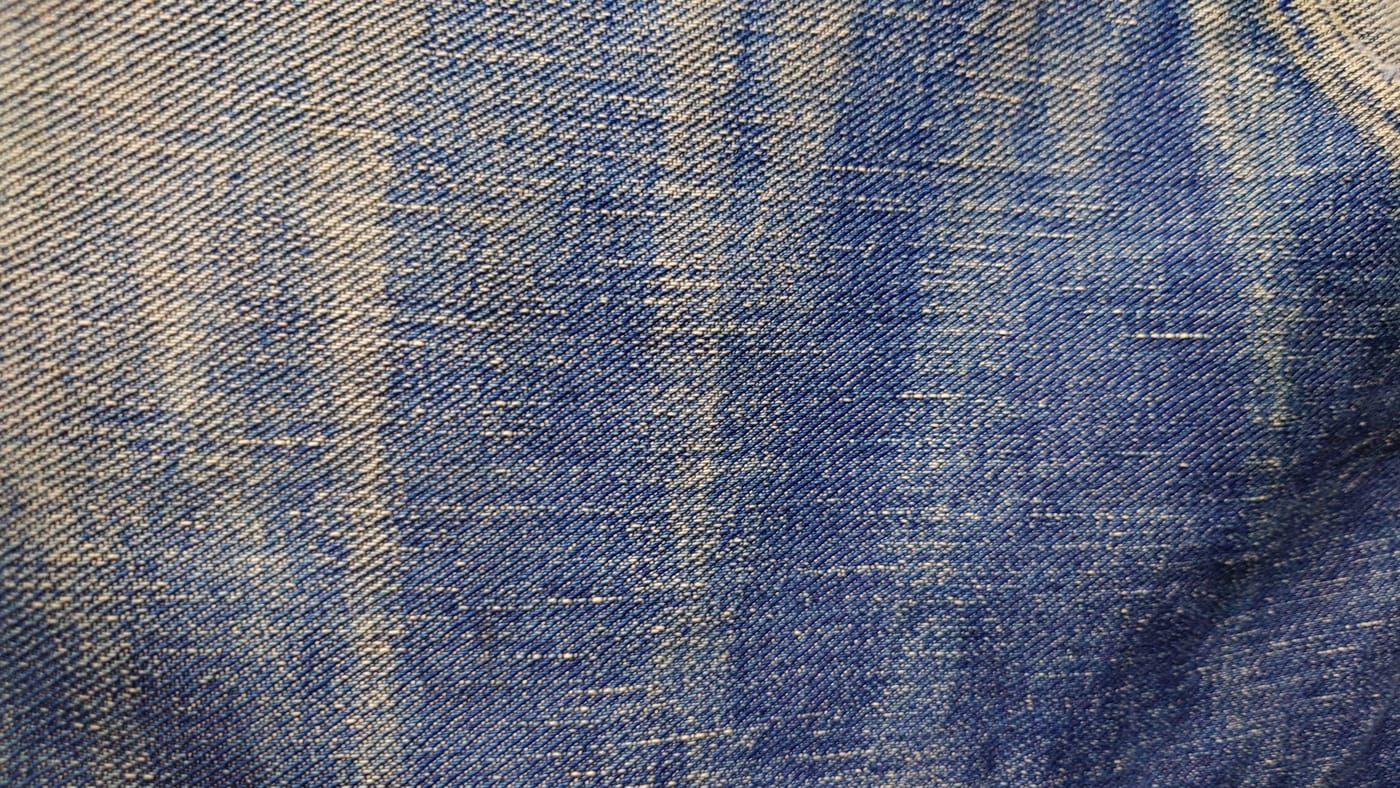
A close-up of a pair from our own collection. Columns of retained indigo alternate with washed-out lighter streaks, and the surface carries the ridged unevenness left by yarn of varying thickness. This is what "the warp structure printed onto the surface by wear" actually looks like on real cloth. (Editorial photo)
Slub Yarn and Ring Spinning: Where the Variation Comes From
Two upstream factors in yarn production are most commonly cited as the technical origin of tate-ochi: ring spinning and slub (mura) yarn.
Ring Spinning vs. Open-End Spinning
The dominant method of spinning cotton into yarn for most of denim's history — through Levi's golden era at Cone Mills in Greensboro, through Wrangler's western cut heyday, through the Lee Storm Rider years — was ring spinning. In this process, a drafted ribbon of cotton fiber is fed through a rotating ring-and-traveler mechanism that simultaneously draws and twists the fibers into a continuous thread. Ring spinning is slow and mechanically intensive, but the resulting yarn has a characteristic structure: fibers are twisted in a helical alignment, with longer fibers wrapping around shorter ones and a proportion of "wild" fibers protruding from the surface. That surface hairiness is part of why ring-spun denim softens so dramatically with wear.
Critically, ring spinning does not guarantee perfect uniformity. The raw cotton itself — even from the same harvest, the same gin — contains fibers of varying length and maturity. As those fibers are drafted and twisted, micro-variations in thickness emerge naturally along the thread. This is the basis of slub yarn (mura-ito in Japanese): yarn with intentional or inherent thick-thin irregularities distributed along its length. In a vintage context, the slub was rarely "designed" — it was simply the natural byproduct of spinning imperfect natural fiber on imperfect machinery. Cone Mills White Oak plant, which supplied Levi's for decades before closing in 2017, produced ring-spun selvedge fabric on vintage shuttle looms; the slight inconsistencies in their yarn are legible today in the fades of jeans woven from that cloth.
Open-end spinning — also called rotor spinning — arrived as an industrial scaling technology in the 1960s and 70s and became widespread through the 1980s. In this method, fiber is fed into a rapidly rotating rotor that centrifugally assembles the yarn. The process is dramatically faster than ring spinning and produces yarn with excellent consistency. That consistency is a genuine quality achievement. But it also means the warp threads in open-end-spun denim are nearly identical to one another — and nearly identical threads produce nearly identical fades. The vertical streaking disappears. The indigo washes off in even horizontal bands, and what you're left with is a uniform, flat blue-to-white gradient with no surface drama.
The shift from ring spinning to open-end spinning in mainstream denim production tracks closely with the period collectors describe as the "end" of naturally occurring tate-ochi in mass-market jeans.
How Much Does the Loom Matter?
A parallel conversation in collector circles concerns shuttle looms versus modern projectile or air-jet looms — and their relationship to tate-ochi. The argument is worth examining carefully, because it's partly structural and partly overstated.
What the structure supports: Shuttle looms weave fabric by passing a shuttle carrying weft yarn back and forth between warp threads. They operate at low speed and under relatively low warp tension. The weft thread loops back on itself at each selvedge edge, creating the self-finished edge we call selvedge. The low-tension weaving environment means the warp threads are not under significant mechanical stress during fabric formation, preserving the natural variation in their twist and diameter. The resulting fabric tends to be somewhat uneven in texture — which, combined with slub yarn, creates conditions favorable to tate-ochi.
Modern rapier, air-jet, and water-jet looms operate at dramatically higher speeds and tensions. The higher tension can compress warp thread variation, producing a more uniform fabric surface. Additionally, these looms cut the weft at each selvedge rather than looping it, which is why modern denim has overlock-stitched edges rather than self-finished ones.
What needs a caveat: The causal chain — shuttle loom → low tension → preserved yarn variation → tate-ochi — is theoretically coherent, but the real-world contribution of the loom type, independent of yarn characteristics, is difficult to isolate. Selvedge fabric woven on shuttle looms from open-end-spun yarn will not fade with strong tate-ochi, because the yarn itself is too uniform. Conversely, some contemporary fabric manufacturers have achieved tate-ochi-prone cloth using modern equipment by specifically engineering slub into the yarn. The loom matters, but the yarn matters more. Selvedge construction and tate-ochi are correlated — because both tend to occur together in the same production contexts — but selvedge is not the cause of tate-ochi.
At NJNL, we flag this as a hypothesis worth holding loosely: the shuttle loom contributes to conditions that allow yarn-level variation to survive into the finished fabric, but it is not, on its own, a reliable predictor of whether a particular pair will streak vertically.
Why Tate-Ochi Looks the Way It Does
Granted the structural explanation — uneven ring-spun warp threads carry indigo unevenly and release it unevenly under wear — the visual result is a fabric surface that catches light differently across its width. The threads with denser fiber packing hold indigo deeper; the thinner sections lose it faster. After months or years of wear, the thigh panel of a well-faded pair develops something like a topographic map in indigo: ridges and valleys of color that trace the original irregularity of the yarn.
This is also why tate-ochi interacts so strongly with light. Under direct or raking light, vertical streaks of white-blue pop against lanes of deep indigo. The effect is three-dimensional — the leg appears to have actual surface texture even when lying flat. In photographs of vintage Levi's 501s or 505s from the 1950s and 60s, this depth is part of what makes the fades look so alive compared to a modern mass-market pair faded to uniform pale blue.
| Factor | Contribution to Tate-Ochi | Confidence Level |
|---|---|---|
| Ring-spun yarn | High — fiber variation survives into yarn | Well-documented |
| Slub / mura yarn | High — intentional or natural thick-thin irregularity | Well-documented |
| Shuttle loom (low tension) | Medium — preserves yarn variation in fabric | Plausible, hard to isolate |
| Rope dyeing penetration depth | Medium — affects how unevenly indigo releases | Widely cited |
| Wearer body mechanics | Variable — gait and friction patterns shape where streaks appear | Observational |
The Psychology: Why We Find It Beautiful
None of the above explains why tate-ochi is considered desirable. That's a cultural question, and it has a few honest answers.
Time made visible. A uniform fade can happen quickly, and it doesn't tell you much. Tate-ochi requires a specific fabric — one that was never going to be cheap to produce — worn long enough for minute structural differences to compound into visible contrast. When you see strong vertical streaks on a pair of jeans, you're looking at evidence that the person who wore them bought an unusual material and then put real time into it. The pattern is a receipt.
Unpredictability as value. You cannot will tate-ochi into existence by washing a pair of jeans a certain way. You can choose a ring-spun slub fabric and increase the probability, but the pattern itself — where the streaks fall, how wide they are, how the contrast develops — is not under your control. This randomness is part of the appeal. The jeans do something you didn't design. For a category of clothing that is often discussed in terms of personal expression, tate-ochi is one of the few elements that the jeans express independently of the wearer.
Visual structure on the body. Vertical lines are a classic tool in clothing design for creating the impression of length and narrowness. A thigh panel with well-developed tate-ochi has a built-in graphic element that articulates the leg's shape. This isn't abstract — it's why a faded vintage pair photographs so differently from a flat, unworn pair of the same cut. The fade pattern does visual work.
Individual variance. Two people can wear the same run of fabric cut from the same bolt and develop completely different tate-ochi patterns based on how they walk, what they do in the jeans, and how their thigh contacts the fabric. This individuation is part of what raw denim culture is built on — the idea that the object records the person. Tate-ochi is one of the more legible ways that recording happens.
What This Means in Practice
For readers evaluating fabric for tate-ochi potential, the most reliable indicators remain yarn construction and the production context of the fabric. Ring-spun warp with some slub character, rope-dyed in traditional fashion with limited dye penetration to the yarn's core (the dye-depth differential is where the vertical lines are actually programmed in), woven under low tension — these are the conditions under which tate-ochi has historically emerged. The historic Cone Mills White Oak selvedge, used in Levi's Vintage Clothing reproductions and various other collections, is a documented example of cloth with this character. So is selvedge fabric produced in the Okayama region of Japan on preserved shuttle machinery using ring-spun yarn. (Whether a modern reproduction can ever truly match a specific vintage pair's streaking is its own honest question — the structural conditions are reproducible; the exact artifact is not.)
But the broader point is this: tate-ochi is not the only legitimate outcome of wearing raw denim. A pair that fades uniformly is not a lesser pair — it is a pair with different material DNA. The uniform fade records time just as honestly; it simply records it differently. Comparing fade patterns between different fabrics is interesting. Declaring one the correct result is a category error.
Denim, like most things worth caring about, resists being fully optimized. The same fabric, on two different people, becomes two different objects. Tate-ochi is one of the more dramatic illustrations of that fact — which is probably why it keeps coming up in conversations about what makes a pair of jeans worth keeping.
Denim can be explained by science. It just can't be replicated by science alone.
Sources & References
- Collier, B.J. & Tortora, P.G. — Understanding Textiles (Pearson), chapters on yarn formation and ring vs. open-end spinning mechanics
- Kadolph, S.J. — Textiles (Pearson), selvedge construction and loom tension characteristics
- Cone Mills White Oak Plant historical documentation and closure reporting (2017), various trade press sources
- Levi Strauss & Co. archival fabric sourcing records, cited in Levi's: A History (Abrams, 2018)
- Raw denim community fade documentation: r/rawdenim Wiki, "Understanding Fades" community guide (public, accessed 2026)
- Textileexchange.org — fiber and spinning method technical glossaries (open access)
- Japan Denim Summit public panel recordings on slub yarn specification and fade outcomes (2024)
Share this article
Related Articles
- Fade TheoryWhat One Year of Raw Denim Wear Actually Produces — Whiskers, Honeycombs & Rivet Stars ExplainedA phase-by-phase analysis of the standard 12-month raw denim base fade arc — covering whisker mechan…
- Fade TheoryThere's No Such Thing as a “Good Fade” — The Longest Wearer Always WinsRing dyeing, fabric character, and the myth of washing abstinence: why denim fading has no right ans…
- Fade TheoryRaw Denim at 30 Days — The Early Fade Signals You're Looking For (And Why They Matter)After 30 days of wear, the first whisker geometry and knee rise are already forming — subtle but str…
- Fade TheoryNatural vs Synthetic Indigo in Denim — How Dye Source Shapes the FadeNatural and synthetic indigo share the same chemical formula, yet differ fundamentally in purity, hu…
- Fade TheoryDoes Washing Accelerate Denim Fading? — Untangling the Science of Wash Frequency & Indigo LossEvery wash, your raw denim looks a shade lighter. But is the machine actually creating that fade — o…
Related Articles
Articles in the same category:
- Denim Honeycomb Fade Explained: 3-Stage Formation Process & 4 Tips to Deepen the Crease Pattern
- Denim Atari Fade Patterns Explained: Tate-Ochi, Yoko-Ochi, Dan-Ochi & Marble — 4 Types Compared
- How Often Should You Wash Raw Denim — The Monthly / 3-Month / 6-Month / Never Debate
- How to Choose the Right Detergent for Raw Denim — Neutral, Mild-Alkaline & Specialist Options
Go Deeper — Books and Films
A few books and films that sit alongside this article — denim and American culture, read and watched.
- Rebel Without a Cause (1955)
James Dean made denim the uniform of teenage rebellion. The starting point for everything that came after. - The Wild One (1953)
Marlon Brando and the motorcycle jacket. The film that built the biker-and-denim archetype. - Easy Rider (1969)
The American New Cinema landmark. Freedom, the open road, and denim as a way of life.
This site uses affiliate links. Purchases made through these links support NJNL at no extra cost to you.