Why Slub Yarn Creates That Vintage Look — The Structure of Depth in Denim Fading
The Science of Fading · 2026-06-02 · ~1,900 words · ~9 min read
Contents (6)
- The Short Answer First — Thick-Thin Variation Creates a Rhythm of Light and Dark
- What Slub Yarn Is — Ring-Spinning and the History of Uniformity
- How Indigo and Slub Yarn Interact
- The Variables That Shape How Much Slub Actually Matters
- Putting It Together — What Slub Yarn Actually Explains
- Related Articles
Anyone who has spent time in the raw denim community has probably heard some version of this observation: vintage denim just fades differently. You can put in the same hours, the same wash cycles, the same abuse — and somehow a pair of deadstock 1960s Levi's 501s comes out looking dimensional and rich where a modern mass-market pair looks flat. There are several reasons for this gap, but one of the most structurally interesting is slub yarn — what Japanese denim culture calls mura-ito, literally "uneven yarn." This article unpacks what slub yarn actually is, how it interacts with indigo, and why that unevenness translates into fading depth.
The Short Answer First — Thick-Thin Variation Creates a Rhythm of Light and Dark
Slub yarn is yarn that is not uniform in diameter. Within a single length of thread, you get thicker sections alternating with thinner ones. In ring-spun cotton, this variation arises naturally from the mechanics of the spinning process — fibers can't be drawn and twisted with perfect consistency, so some deviation in diameter is almost inevitable.
That variation matters for dyeing. Thicker sections of yarn present more surface area and absorb more indigo. Thinner sections take on comparatively less. The result is a thread that already carries a built-in gradient of dye concentration before a single yard of fabric is woven. Once the denim is constructed and you start wearing it, friction and washing begin to strip indigo away — and it strips away faster where there was less dye to begin with. The thin sections lighten earlier. The thick sections hold color longer. Over hundreds of hours of wear, that differential compounds into what we recognize as depth: a complex, uneven fade that catches light differently depending on angle.
That's the mechanism. Now let's look at how we got here historically and why it matters for understanding modern denim.
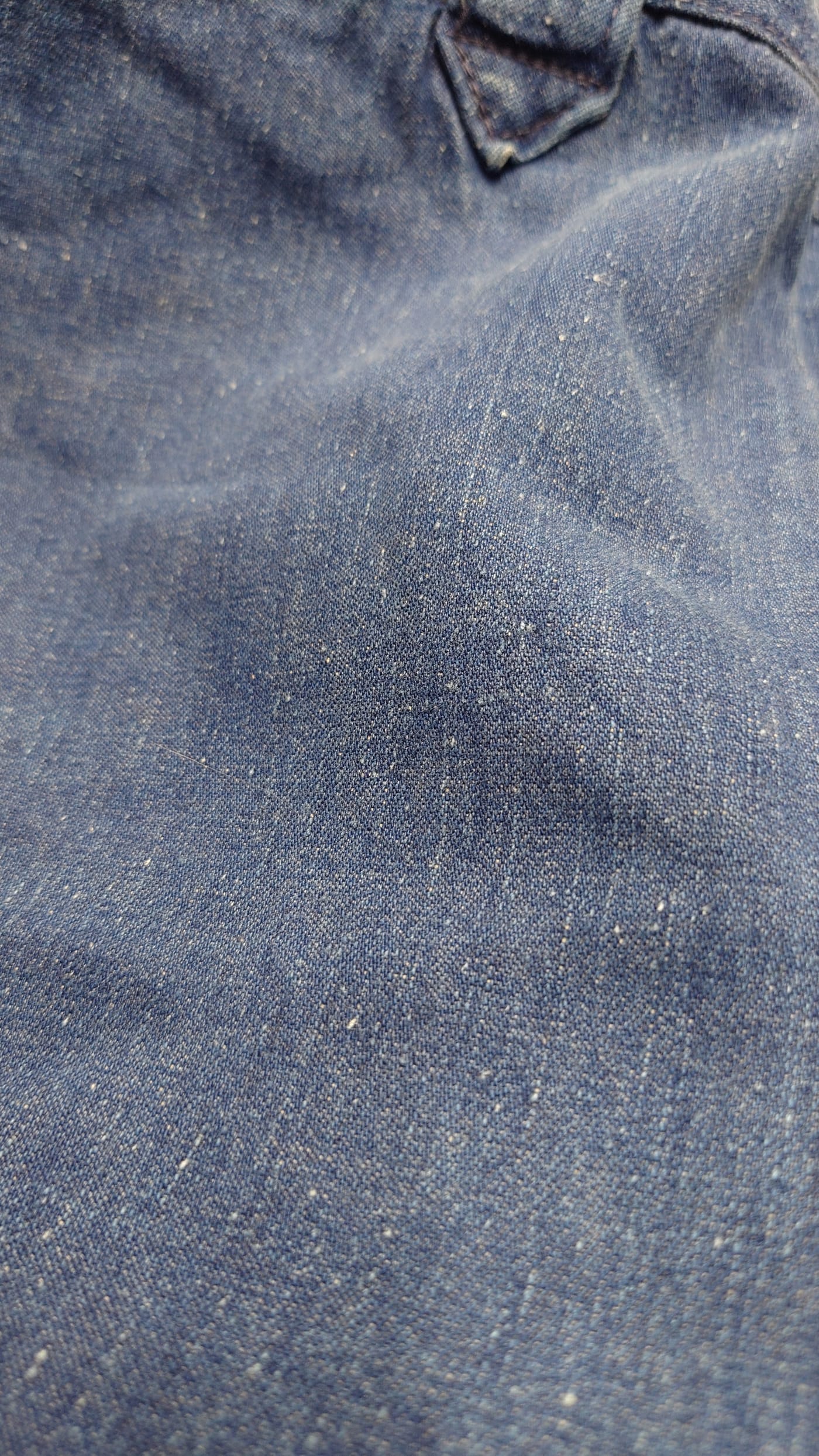
A close-up of pale indigo cloth from our own collection. The yarn diameter is visibly inconsistent, with small nubs and ridges scattered across the surface — exactly the kind of thick-thin irregularity described above. This unevenness in the yarn is the foundation of the "rhythm of light and dark" the fade eventually reveals. (Editorial photo)
What Slub Yarn Is — Ring-Spinning and the History of Uniformity
How Yarn Is Made
Cotton fiber goes through a multi-stage process to become thread: the raw cotton is cleaned and carded (combed into parallel alignment), then drafted (drawn out into a thin rope called roving), then spun (twisted under tension to lock the fibers together into a stable yarn). The machine that handles that final step in ring-spinning is called — logically — a ring frame. A spindle rotates, pulling fiber through a small metal guide ring while simultaneously twisting it.
The inherent limitation of ring-spinning is that fiber alignment during the drafting stage is never perfectly uniform. Some fiber bundles are slightly denser, others slightly thinner, and those variations carry through into the finished yarn as diameter fluctuations. For centuries this was simply a property of cotton thread — unavoidable, unremarkable, and present in every pair of workwear trousers ever made, including the original Levi Strauss & Co. waist overalls of the 1870s.
The Open-End Revolution and Why It Changed Everything
In the 1960s and 1970s, open-end spinning (also called rotor spinning) was commercialized at scale. Instead of twisting fiber continuously on a ring frame, open-end machines break the fiber stream apart and reform it inside a rapidly rotating rotor. The physics of this process produce much more consistent yarn diameter. Open-end yarn is smoother, more uniform, and can be produced significantly faster with less labor.
For denim manufacturers under pressure to reduce cost and increase output — which describes virtually the entire American denim industry from the early 1970s onward — open-end spinning was transformative. Cone Mills in North Carolina, which had supplied Levi's with selvage denim woven on shuttle looms, eventually shifted much of its production toward modern weaving equipment fed by open-end yarn. The change was driven by economics, not aesthetics. Uniform yarn was simply cheaper to produce.
The unintended consequence became obvious only later, when enthusiasts began comparing pre-1970s Levi's 501s against later production. The older pairs faded with a texture and dimensionality that newer ones couldn't replicate. The ring-spun, slubby yarn of the earlier era — woven on shuttle looms into true selvage fabric — had been producing a visual complexity that nobody had particularly valued while it was standard. It only became legible as a quality once it was gone.
This is partly why the "vintage reproduction" denim wave that emerged in Japan in the 1980s and 1990s placed such emphasis on ring-spun yarn and shuttle-loom construction. The goal was to reproduce not just the silhouette of classic American workwear, but the material conditions that produced a particular kind of fade.
How Indigo and Slub Yarn Interact
Dye Uptake Along an Uneven Thread
Indigo is a surface dye. Unlike fiber-reactive dyes that chemically bond into the cellulose of cotton, indigo adheres to the outer layers of the yarn and does not fully penetrate to the core — a property called ring dyeing or surface dyeing, which is why indigo fades at all rather than remaining colorfast. The dye is literally sitting on the outside of the yarn, and wear abrades it away layer by layer.
When you dye a slubby, ring-spun thread, the thick sections pick up more indigo molecules per inch of yarn length. The thin sections pick up fewer. At the moment of dyeing, this difference is subtle — the fabric looks roughly uniform to the naked eye. The blue surface appears consistent. The differentiation is latent, encoded in the yarn but not yet visible.
How Wear Unlocks the Gradient
Wear is what makes the latent gradient visible. As denim is subjected to friction — against a thigh, a chair seat, a workbench edge — indigo molecules are displaced and the cotton below begins to show through. In uniform yarn, this process is also relatively uniform: dye strips away at roughly the same rate across the thread, producing a consistent, even fade.
In slub yarn, the differential in dye uptake creates a differential in fade rate. Thin sections, which started with less indigo, reach the lighter end of their fade range faster. Thick sections hold their color longer. The result is a fade that has what the community often calls vertical movement — a rhythmic alternation of light and dark running along the warp threads. This is closely related to what denim culture calls tate-ochi (vertical fading), one of the most sought-after characteristics in high-end raw denim.
Levi's Vintage Clothing reproductions of the 501 specifically target this quality by using ring-spun yarn and shuttle-loom construction, attempting to recreate the fiber conditions of Levi's 1940s–1960s production. The aim is exactly this: a fabric that fades with movement and rhythm rather than in a flat, even wash.
A Note on Causality
It's worth being careful here. Slub yarn is one input into a complex system. Vertical fading is also influenced by loom structure (shuttle looms produce a tighter, more differentiated weave than projectile looms), dye depth (how many indigo dip cycles the yarn went through), finishing treatments, and the specifics of how a garment is worn. Saying "slub yarn causes vertical fading" overstates the case. More precisely: slub yarn creates conditions that make differentiated fading more likely, given appropriate support from the rest of the construction.
The Variables That Shape How Much Slub Actually Matters
Not all slub yarn fades identically, and not every pair made with ring-spun thread will produce dramatic vertical fading. Several variables modulate the effect:
Degree of variation: The amplitude of the thick-thin difference matters. Moderate slub creates a subtle texture; pronounced slub creates a more dramatic dye gradient. Heavily slubbed yarn, sometimes called super-mura in Japanese production contexts, pushes this effect to its extreme — more visual noise upfront, more complex character after years of wear. Heavily uniform ring-spun yarn, on the other hand, may produce some slub character but far less than intentionally irregular spinning.
Dye depth and number of indigo dips: Yarn that has been dipped many times in indigo has a thick shell of dye. The differential between thick and thin sections becomes proportionally smaller relative to total dye load, which can mute the slub effect. Conversely, yarn with a thinner indigo coat will reveal the slub gradient more quickly and dramatically. This is one reason lightly-dipped vintage-style denims sometimes fade in striking ways early in their life.
Wear pattern and friction concentration: The same pair of jeans worn by two different people will fade differently based on body mechanics, work environment, and posture. High-abrasion activities concentrate friction in specific areas, accelerating the slub-driven differential there. Sedentary wear distributes friction more gently and broadly. The slub effect is present in both cases but manifests over different timelines.
Lot variation: Because ring-spun slub is partly a function of natural fiber variation and process tolerance, no two rolls of fabric are identical. Two pairs cut from the same bolt will differ slightly in their slub pattern, which means they'll fade into slightly different faces even under identical wear conditions. This is often cited by collectors as part of what makes vintage and reproduction denim interesting — it's impossible to own two pairs that age in exactly the same way.
Putting It Together — What Slub Yarn Actually Explains
The deeper cultural point here is a value inversion that's specific to denim and a handful of other craft-adjacent categories. In most modern manufacturing contexts, variation is a defect. Tolerances are minimized, uniformity is optimized, and consistency is the measure of quality. Open-end spinning won out in commercial denim production precisely because it produced more consistent yarn faster.
Denim culture — particularly the vintage and reproduction end of it — reverses this logic. The variation is the feature. The slub, the irregular diameter, the subtle gradient of dye uptake: these are not flaws to be engineered out but properties to be preserved and amplified. A pair of Levi's 501s from 1955 is partly interesting because the yarn it was spun from had no particular interest in being uniform. The machinery of the era simply couldn't guarantee it.
What this means practically for anyone evaluating raw denim is that yarn construction is worth understanding even if you never see it directly. When brands describe their fabric as "ring-spun" or note the use of slubby yarn, they are signaling something specific about the kind of fade they are engineering toward — complex, textured, dimensional. Whether that translates into the lived experience of a particular pair depends on many other factors. But slub yarn, understood correctly, is a legitimate input into that outcome: not a guarantee, but a precondition for a certain kind of depth.
Denim can be explained with fiber science. It just can't be replicated with fiber science alone.
Denim is a fabric that science can describe but cannot make look the same twice.
This article draws on publicly available textile engineering literature, historical documentation of American denim manufacturing, brand technical descriptions, and community wear reports. Fade outcomes vary significantly based on body mechanics, fit, wash frequency, drying method, and individual fiber variation. Nothing here should be read as a guarantee of specific results for any product or wearer.
Sources & References
- Lord, P.R. Handbook of Yarn Production: Technology, Science and Economics. Woodhead Publishing, 2003 — foundational reference on ring-spinning vs. open-end mechanics
- Tortora, P.G. & Johnson, I. The Fairchild Books Dictionary of Textiles, 8th ed. — definitions of slub yarn and ring-spun construction
- Downey, L. This Is a Pair of Levi's Jeans: The Official History of the Levi's Brand. Levi Strauss & Co., 1995 — historical context on Cone Mills sourcing and production transitions
- Kuldova, T. & Jacobsen, M.H. (eds.) Fashion and the Consumer — contextual framing on value inversion in craft consumption
- Cone Mills White Oak Plant production documentation (archived, various years) — selvage denim weaving specifications
- Rawdenim community wear logs and fade archives (reddit.com/r/rawdenim, various contributors) — empirical wear pattern observations
Share this article
Related Articles
- Fade TheoryWhat One Year of Raw Denim Wear Actually Produces — Whiskers, Honeycombs & Rivet Stars ExplainedA phase-by-phase analysis of the standard 12-month raw denim base fade arc — covering whisker mechan…
- Fade TheoryThere's No Such Thing as a “Good Fade” — The Longest Wearer Always WinsRing dyeing, fabric character, and the myth of washing abstinence: why denim fading has no right ans…
- Fade TheoryRaw Denim at 30 Days — The Early Fade Signals You're Looking For (And Why They Matter)After 30 days of wear, the first whisker geometry and knee rise are already forming — subtle but str…
- Fade TheoryNatural vs Synthetic Indigo in Denim — How Dye Source Shapes the FadeNatural and synthetic indigo share the same chemical formula, yet differ fundamentally in purity, hu…
- Fade TheoryDoes Washing Accelerate Denim Fading? — Untangling the Science of Wash Frequency & Indigo LossEvery wash, your raw denim looks a shade lighter. But is the machine actually creating that fade — o…
Related Articles
Articles in the same category:
- Denim Honeycomb Fade Explained: 3-Stage Formation Process & 4 Tips to Deepen the Crease Pattern
- Denim Atari Fade Patterns Explained: Tate-Ochi, Yoko-Ochi, Dan-Ochi & Marble — 4 Types Compared
- How Often Should You Wash Raw Denim — The Monthly / 3-Month / 6-Month / Never Debate
- How to Choose the Right Detergent for Raw Denim — Neutral, Mild-Alkaline & Specialist Options
Go Deeper — Books and Films
A few books and films that sit alongside this article — denim and American culture, read and watched.
- Rebel Without a Cause (1955)
James Dean made denim the uniform of teenage rebellion. The starting point for everything that came after. - The Wild One (1953)
Marlon Brando and the motorcycle jacket. The film that built the biker-and-denim archetype. - Easy Rider (1969)
The American New Cinema landmark. Freedom, the open road, and denim as a way of life.
This site uses affiliate links. Purchases made through these links support NJNL at no extra cost to you.