More Than Denim — Herringbone, Hickory & Wabash: The Weaves and Stripes of Workwear
Materials & Yarn · 2026-06-22 · ~1,300 words · ~5 min read
Contents (5)
- First, the Baseline — Denim Is an Indigo Twill
- Herringbone (HBT) — The Diagonal That Folds Back
- Hickory Stripe — Blue-and-White Working Cloth
- Wabash — Dotted Stripes on Indigo
- Weave and Yarn Make the Character of a Fade
Denim is a twill woven from indigo-dyed warp threads and undyed white weft. The diagonal ridges running across its surface are a product of that weave. As the color wears, the tops of those ridges lighten first, and the resulting shadowing is what we call a fade — a mechanism covered in "There's No Such Thing as a 'Good Fade'".
But look across the older world of workwear and there are other "working fabrics" beyond denim. And here's the interesting part: they, too, develop a fade specific to their own weave or stripe as they're worn in. Here are three cloths long valued on the job, seen through their own aging.
First, the Baseline — Denim Is an Indigo Twill
Before the rest, it helps to fix denim as a reference point. Denim's fade looks so distinctive because of two things multiplied together: indigo sits only on the surface of the yarn (ring dyeing), and the 3×1 twill builds diagonal ridges. Friction strips blue from the ridge tops while the valleys keep their dye, producing three-dimensional contrast.
That lens — weave (how the ridges sit) and yarn (thickness and dye unevenness) together decide the look of a fade — applies just as well to fabrics that aren't denim.
Herringbone (HBT) — The Diagonal That Folds Back
Reverse the diagonal ridge of a twill at regular intervals and you get a chevron pattern of stacked Vs. That's herringbone — named for its resemblance to a herring's bones. Because the ridge direction switches back and forth, the cloth tends to weave up tightly and turns out durable. It has long been used where toughness matters: work garments and, notably, WWII-era military uniforms (HBT — herringbone twill).
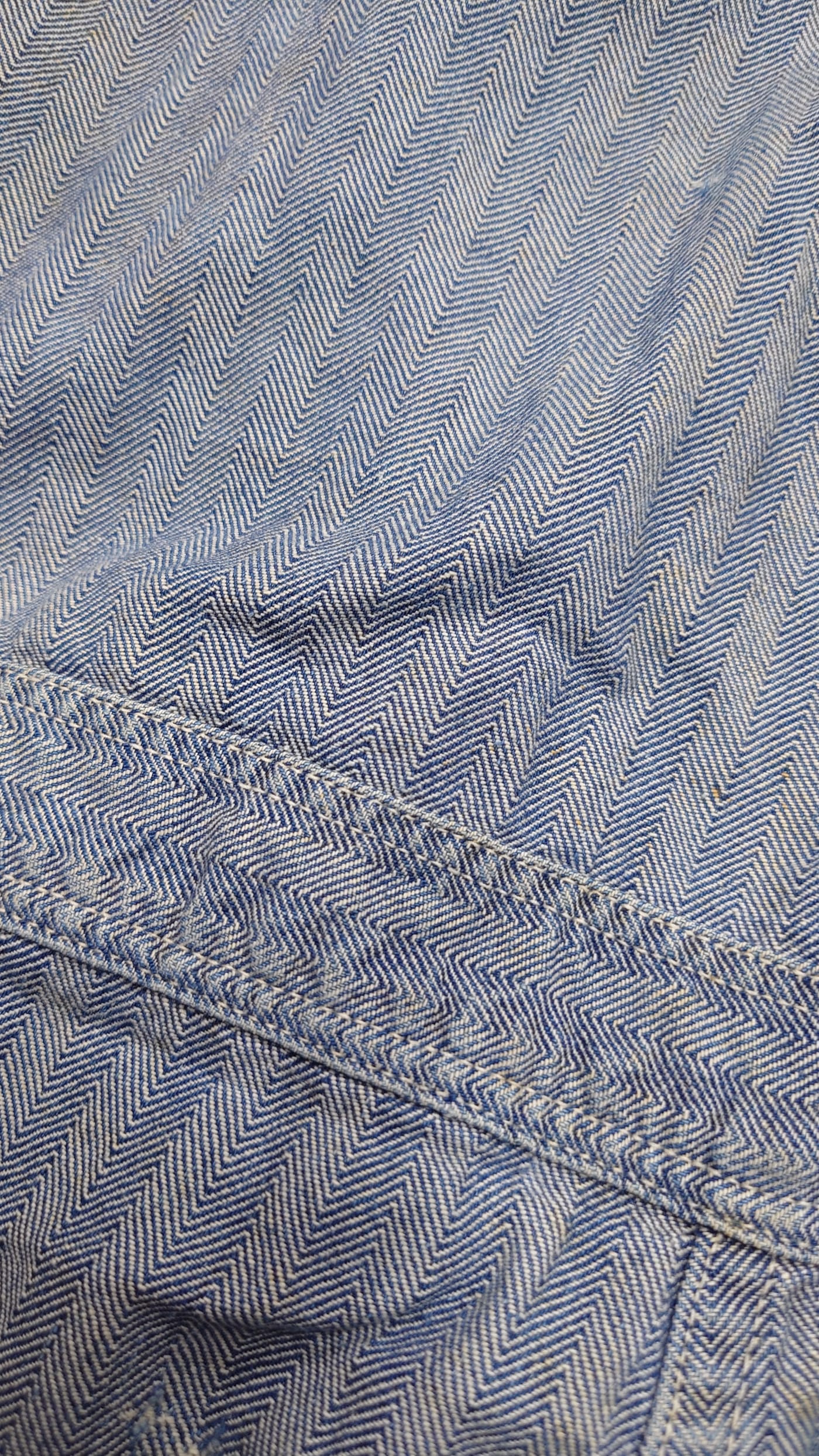
The stacked V-shaped ridges of herringbone — the piece photographed is a 2/2 (serge-structure) herringbone. As color lifts, the tops of these ridges whiten first — producing an arrow-feather shadowing distinct from straight-twill denim. (Editorial photo)
Herringbone is also not one single fabric. The piece in the photo is a 2/2 — serge-structure — herringbone, but 3/1 versions built on the same interlacing as denim exist as well. There are even "SZ herringbones," which alternate S-twist and Z-twist yarns so the chevron effect comes from the yarn twist catching light in opposite directions, not from the weave structure alone. The chevron may look the same at a glance, but the combination of weave and yarn changes how the ridges stand and how the surface plays with light.
The fade follows the structure honestly. Each "peak" of the folding-back chevron takes friction and lightens first, so instead of the broad contrast of a straight-twill denim you get a finer, repeatedly reversing shadow.
Hickory Stripe — Blue-and-White Working Cloth
Hickory is a heavy cotton cloth with thin indigo-and-white stripes, long associated with American railroad workers, painters, and engineers. It hides dirt well, wears hard, and — crucially — its stripe is built into the weave. That's the decisive difference from wabash (below), which dyes and then removes: hickory weaves the stripe from differently colored yarns from the start.
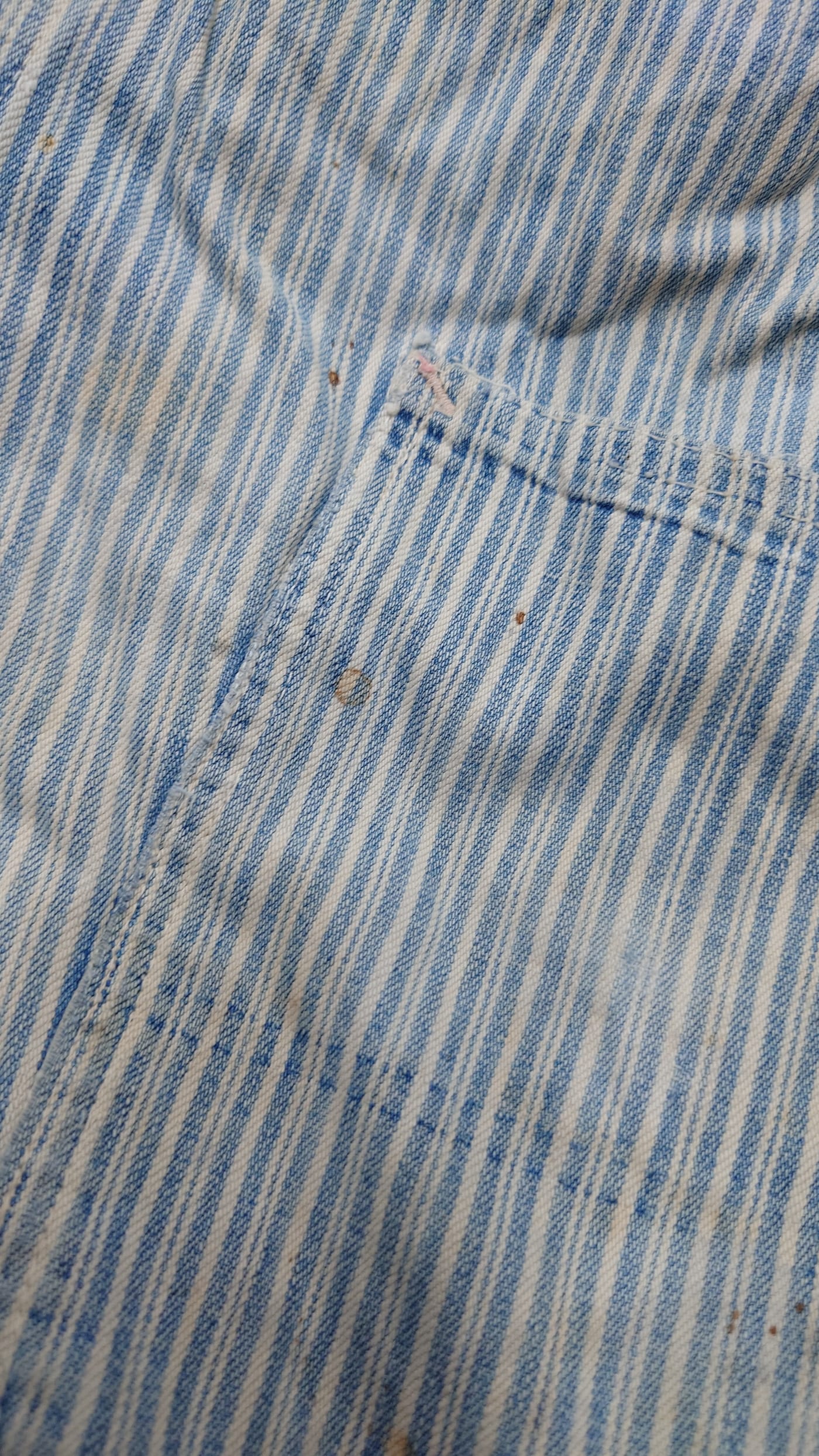
The woven blue-and-white stripe. With wear, the indigo yarns lighten and the contrast with the white softens, mellowing the whole cloth. (Editorial photo)
As it fades, the blue stripe lightens while its contrast with the white eases off. Rather than denim's broad surface contrast, hickory ages by letting the crispness of its stripe gradually relax — a maturation particular to it.
Wabash — Dotted Stripes on Indigo
Wabash is an indigo-ground cloth carrying fine dotted pinstripes in white. It's generally described as a discharge print: chemicals remove color in spots from the dyed cloth to leave the white dots. It was common in early-twentieth-century American workwear — most famously from Stifel (J.L. Stifel & Sons), the American maker known for its boot-shaped trademark.
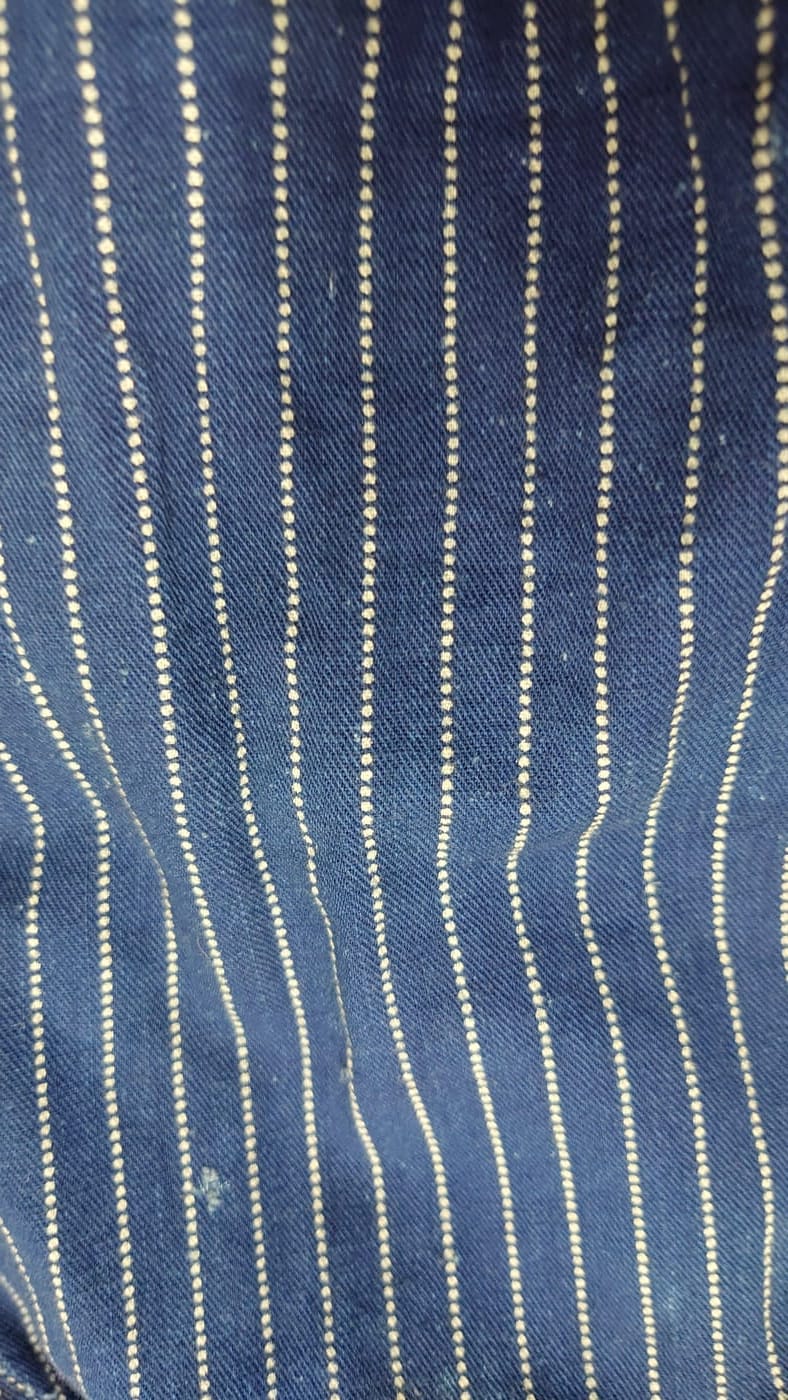
Dotted white pinstripes on an indigo ground. Up close, each stripe resolves into a row of small dots. The more the ground indigo fades, the more this stippled character steps forward. (Editorial photo)
If hickory is a "woven stripe," wabash is a "dyed stripe" — so its fade runs the opposite way. As the indigo ground wears and washes lighter, the contrast with the discharge-printed dots tends to grow more pronounced, not less.
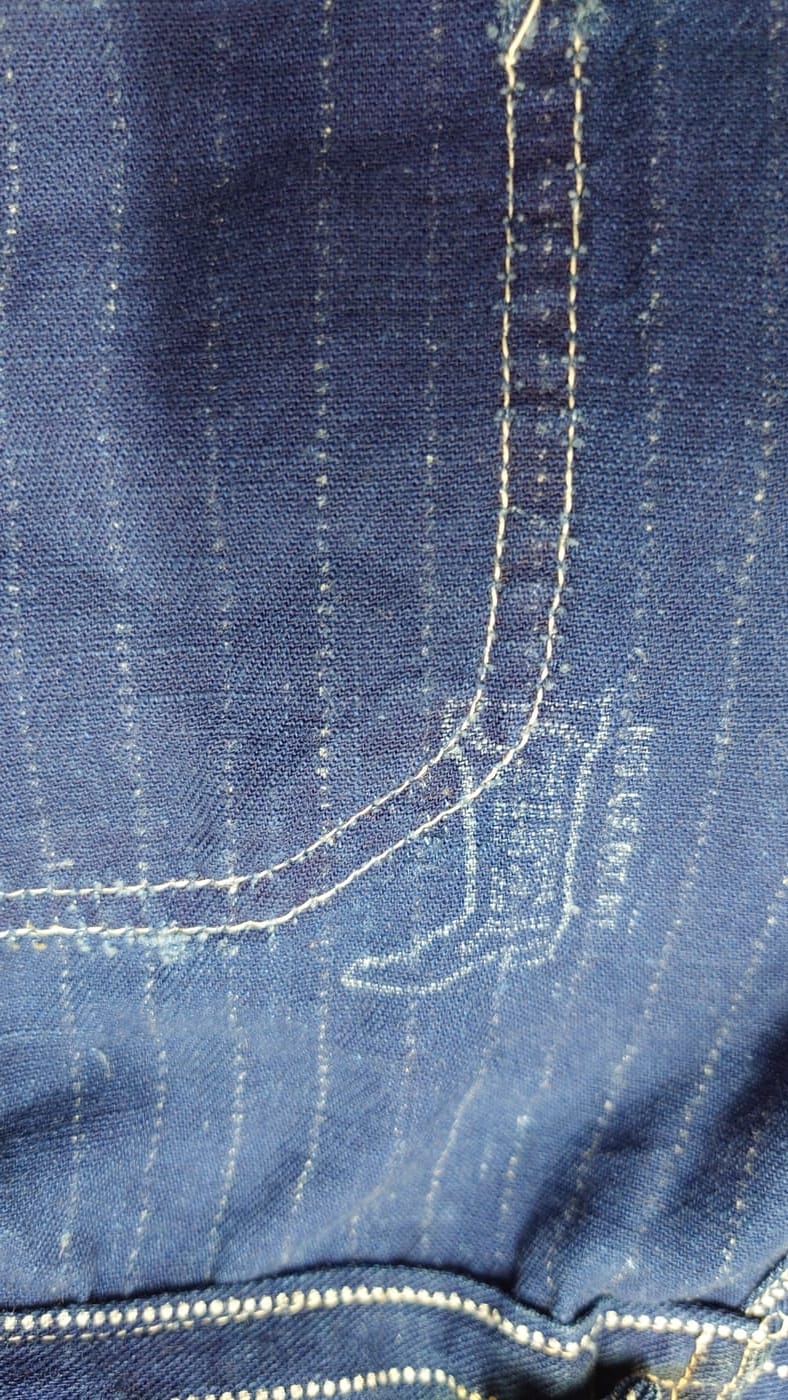
The reverse side of the same cloth. Alongside the construction stitching, a faint boot-shaped stamp survives in the center — the trademark Stifel printed on the back of its fabric. Turn the cloth over and you knew whose it was: period workwear's proof of quality. (Editorial photo)
Weave and Yarn Make the Character of a Fade
Even with the same indigo, a different weave moves the ridges and changes where the cloth rubs. Add the character of the yarn itself — slub yarn of uneven thickness, or cotton full of neps (knots) — and the landscape of the fade splits further from one piece to the next. (How yarn is spun is covered in "Spinning and Yarn Count".)
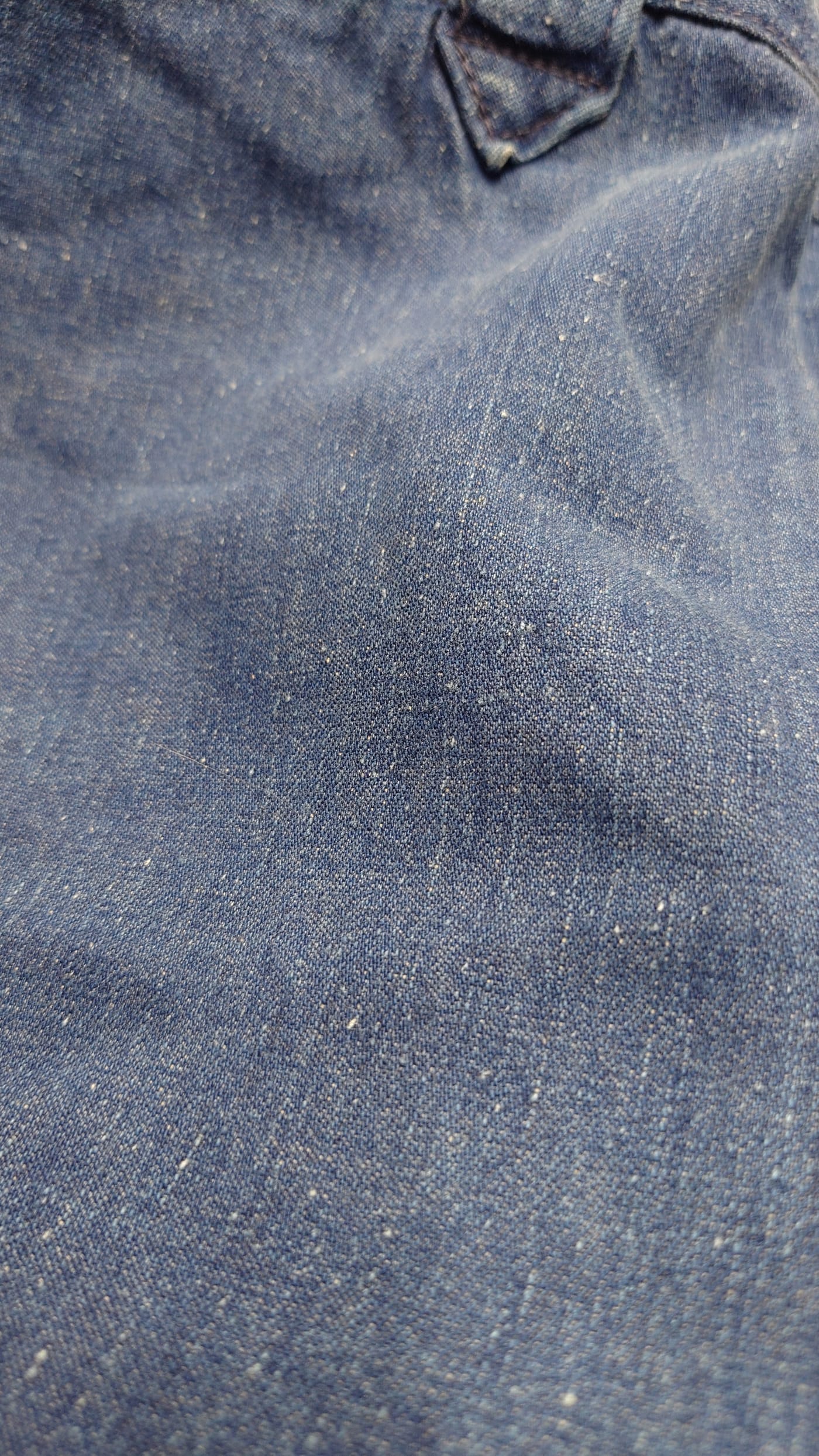
Cloth scattered with neps, plain and rustic. The character of the yarn becomes, directly, the character of the fade. (Editorial photo)
An eye used to reading cloth on the factory floor doesn't see these differences as better or worse. It just reads them: "this weave gives that shadow," "this yarn lifts that way." Denim, herringbone, hickory, wabash — none is above the others. Each one's way of working, and its time, leaves its own expression in the cloth.
For the structure of weaving itself, one level deeper, see "Denim Weaving and Selvedge". The fade of a working cloth is a collaboration of weave, yarn, and time.
Sources & References
- Tortora, P. G., Fairchild's Dictionary of Textiles (definitions of herringbone twill and striped fabrics)
- Standard textile-engineering texts (general descriptions of twill structure and discharge printing)
- General costume-history sources on twentieth-century American workwear and military uniforms
Share this article
Related Articles
- Materials & YarnSlub Yarn Denim — How Intentional Irregularity Creates Texture and Unique Fade PatternsSlub yarn isn't just a texture detail — the interplay between node geometry, indigo dye behavior, an…
- Materials & YarnCarded vs Combed Yarn in Selvedge Denim — How One Spinning Step Shapes Fade CharacterThe difference between carded and combed yarn comes down to a single added process — combing. But th…
- Materials & YarnZimbabwe Cotton in Denim — Rain-Fed Cultivation, Hand-Picking, and What They Mean for FadeZimbabwe cotton's reputation in selvedge denim circles extends well beyond its organic credentials. …
- Materials & YarnHigh-Twist Yarn Denim — Why That Sharp Contrast Fade Costs You LongevityHigh-twist yarn delivers the crisp, high-contrast fades that photos love. But eight months of hard w…
- Materials & YarnWhy Denim Is Blue on the Front and White on the Back — The Warp/Weft Division of LaborFlip your raw denim inside-out and you'll see it: deep indigo on the face, near-white on the reverse…
Go Deeper
For a brand-by-brand look at where these weave and stripe variants still show up, this illustrated manual is the standard technical reference.
📖 Find it on Amazon
As an Amazon Associate we earn from qualifying purchases.
Related Articles
Articles in the same category:
- Denim Honeycomb Fade Explained: 3-Stage Formation Process & 4 Tips to Deepen the Crease Pattern
- Denim Atari Fade Patterns Explained: Tate-Ochi, Yoko-Ochi, Dan-Ochi & Marble — 4 Types Compared
- How Often Should You Wash Raw Denim — The Monthly / 3-Month / 6-Month / Never Debate
- How to Choose the Right Detergent for Raw Denim — Neutral, Mild-Alkaline & Specialist Options
Go Deeper — Books and Films
A few books and films that sit alongside this article — denim and American culture, read and watched.
- Rebel Without a Cause (1955)
James Dean made denim the uniform of teenage rebellion. The starting point for everything that came after. - The Wild One (1953)
Marlon Brando and the motorcycle jacket. The film that built the biker-and-denim archetype. - Easy Rider (1969)
The American New Cinema landmark. Freedom, the open road, and denim as a way of life.
This site uses affiliate links. Purchases made through these links support NJNL at no extra cost to you.