Why '70s Denim Fades Different — Materials, Production Shifts & the Transition Decade
Vintage & Era Analysis · 2026-06-03 · ~1,900 words · ~9 min read
Contents (9)
- The Short Answer: The '70s Were a Transition Decade
- The Production Boom That Changed Everything
- Yarn: Ring-Spun Holdover and the Open-End Transition
- Dyeing: Rope vs. Slasher, and What the Core Tells You
- Silhouette and Fabric Weight: The Bell-Bottom Factor
- What "Distinctive" Actually Means When You Hold a Worn Pair
- Practical Notes for Anyone Hunting '70s Denim
- No Jeans No Life Summary
- Related Articles
Spend enough time in vintage denim circles — on the forums, at the swap meets, scrolling through worn-in photos on the raw denim subreddit — and you'll hear a particular opinion surface quietly but consistently: the '70s stuff fades different. Not better or worse than a '47 or a '66, but genuinely distinct. A pair that someone has worn for years develops a quality that doesn't quite map onto the high-contrast vertical fade of a selvedge-era piece, nor the flat, uniform wash-out of a modern mass-market jean.
So what's actually going on? Why does denim made between roughly 1970 and 1979 occupy its own lane when it comes to how it ages? This article works through the production history, material shifts, and textile transitions that define the decade — and tries to give a coherent answer to a question that's harder than it first looks.
The Short Answer: The '70s Were a Transition Decade
If you want one frame to hold everything else together, it's this: the 1970s sit squarely between two eras of denim production, and that in-between status is exactly what makes its fades distinctive.
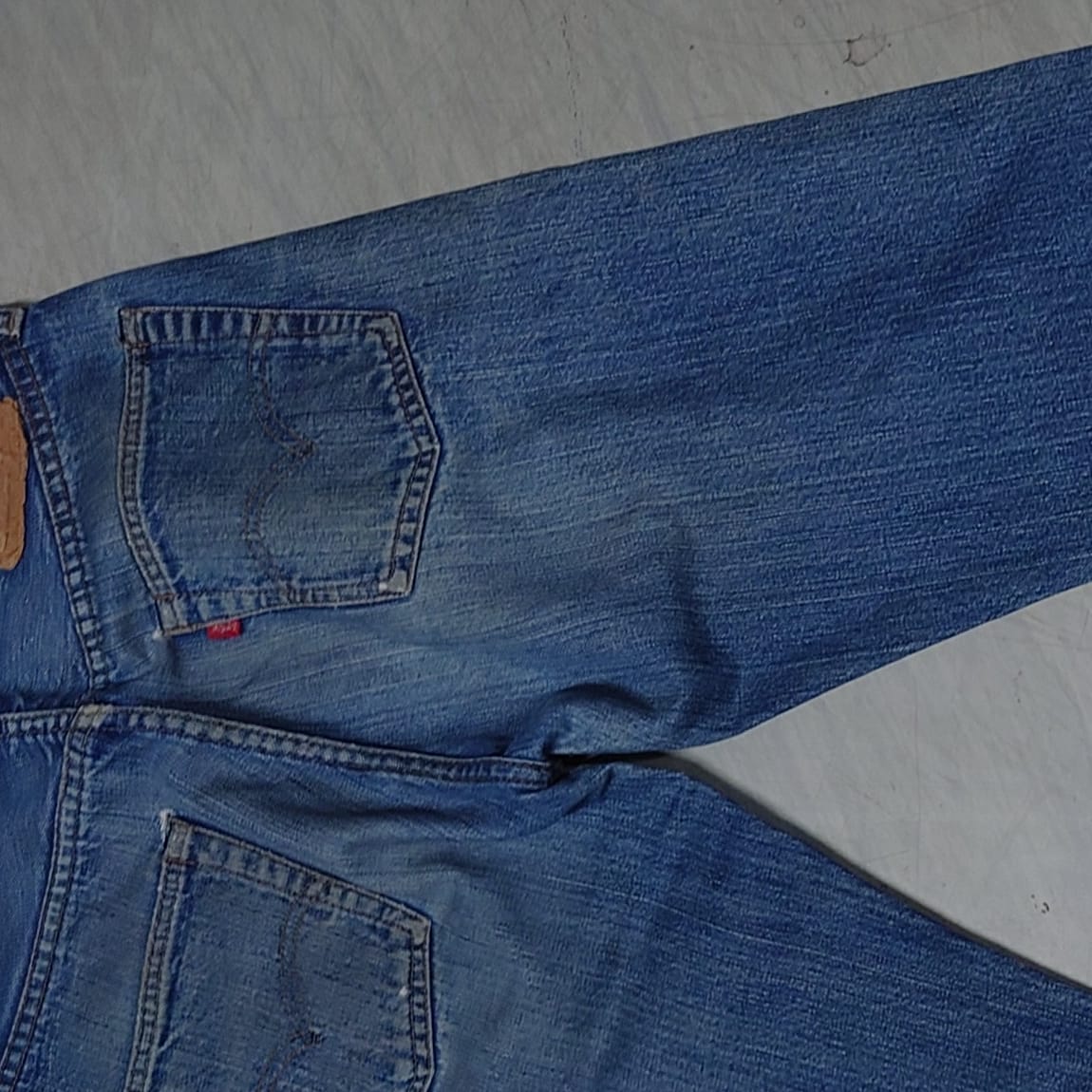
A real worn Levi's 66 (the "66-zenki" model), paper patch and all — shown here as a reference point for that in-between look. The fade is neither the high-contrast vertical streaking of a selvedge-era piece nor the flat wash-out of a modern jean, but a soft, even fade with little mottling. (Real pair, photographed by the editor.)
On one side: the 1950s and early '60s, the era that collectors fetishize most — ring-spun yarns with natural slub and irregularity, deep rope-dyed indigo with a pronounced white core, relatively limited production runs, and heavy-weight denim built for work. Levi's Big E era, Cone Mills White Oak plant running at full tilt on selvedge looms, the fabric that became the template for every Japanese repro brand that followed.
On the other side: the 1980s onward, when large-scale industrialization fully landed — open-end spun yarn, slasher dyeing running at speed, projectile and rapier looms replacing selvedge shuttle looms, lighter-weight constructions optimized for global scale. The denim that most people alive today grew up wearing.
The 1970s are neither. They're the hinge. And the fades from that decade carry the evidence of that hinge in every crease, whisker, and honeycombed pocket corner.
The Production Boom That Changed Everything
The backdrop matters enormously here. Denim's explosion from workwear into mainstream American culture — and from American culture into global fashion — happened fast and happened hard in the late '60s and early '70s. Easy Rider (1969) is the cultural marker most people cite, but the economic data tells the same story: U.S. denim production volumes climbed steeply through the early and mid-1970s toward what historians of the textile industry recognize as the peak of American domestic denim output.
Cone Mills, the dominant denim fabric supplier to Levi's for decades, was running at enormous capacity. Levi Strauss & Co. itself was expanding manufacturing aggressively — domestic plants, then international ones. Wrangler and Lee were doing the same. The market wasn't niche. It was everyone, everywhere, all at once.
That scale of demand forces production decisions. Not all of those decisions preserve the material qualities that make old denim fade beautifully. Some of them move in exactly the opposite direction.
| Era | Yarn Type | Dyeing Method | Loom Type | Typical Weight |
|---|---|---|---|---|
| Pre-'60s | Ring-spun, high slub | Rope dyeing | Selvedge shuttle | 13–14.5 oz+ |
| 1970s (transition) | Ring-spun → Open-end mix | Rope → Slasher transition | Mixed | Variable |
| Post-'80s | Open-end dominant | Slasher dominant | Projectile/rapier | 11–13 oz |
This table is a simplification — the reality within each decade varied significantly by manufacturer, plant, and year — but it captures the directional shift that was underway throughout the '70s.
Yarn: Ring-Spun Holdover and the Open-End Transition
One of the most discussed variables among denim researchers and serious collectors is yarn construction. Ring-spun yarn — the older method — produces fiber with natural irregularities (slubby yarn). The twist isn't perfectly uniform. There are thick spots and thin spots, subtle variations in how the indigo adheres, micro-differences in how the yarn sits in the weave. These irregularities are what generate the vertical streaking — the "tate-ochi" — that collectors associate with premium vintage fades.
Open-end (or rotor) spinning, which became commercially viable at scale in the late 1960s and saw rapid adoption through the 1970s, produces a more uniform yarn. Faster to make, cheaper per unit, consistent in diameter. Great for production efficiency. Less interesting for fade dynamics.
Here's the complication: the transition wasn't simultaneous across manufacturers. Some brands were running open-end yarns on certain products by the early 1970s. Others were still running ring-spun mid-decade. Some mixed them. The result is that two pairs of jeans with the same label, the same year of manufacture, and similar retail pricing might have meaningfully different yarn constructions — and will fade differently because of it.
This is why experienced vintage buyers examine the denim itself, not just the label. The yarn tells you more than the tag.
Dyeing: Rope vs. Slasher, and What the Core Tells You
The second major variable is dyeing method. Rope dyeing — the traditional technique where yarns are bundled into ropes and passed through indigo vats multiple times — produces a characteristic white core inside each yarn. The indigo penetrates the outer layers but doesn't saturate all the way through. When the denim fades, that white core is revealed gradually, creating the high-contrast, slightly blotchy, characterful fade that vintage enthusiasts love. Levi's White Oak Cone Mills fabric was rope-dyed. The LVC (Levi's Vintage Clothing) reproductions specifically source rope-dyed fabric to replicate this behavior.
Slasher dyeing — also called beam dyeing — runs yarn sheets flat through dye baths at higher speed. More efficient. Higher throughput. But the dye penetration profile differs. The white core is less pronounced or distributed differently. The result when worn tends toward a flatter, more even fade-out rather than the high-drama contrast of rope-dyed fabric.
The 1970s sit in the overlap of this transition. Rope dyeing didn't disappear overnight. Slasher capacity grew. Depending on when and where a specific pair of jeans was made, you might be looking at rope, slasher, or an early iteration of the slasher process that doesn't behave quite like either extreme.
This is the "transition decade" reality made material: the dyeing infrastructure was changing underneath the product, and the fades reflect that.
Silhouette and Fabric Weight: The Bell-Bottom Factor
Beyond yarn and dyeing, the silhouette of 1970s denim is itself a variable in how these pieces age — and it's one that often gets overlooked.
The dominant silhouette of the early-to-mid '70s wasn't the straight-leg 501 that repro brands immortalize. It was the bell-bottom, the flare, the wide-leg. Dramatically wider hems, higher rises on some cuts, a different relationship between fabric and body in motion. This changes the wear pattern. The friction points are different. The stress on the fabric at the knee, the seat, the thighs behaves differently than it does in a straight or slim cut. The resulting fade — especially on a pair that's been genuinely lived in — has a different topography than a 501-style fade.
Fabric weight also drifted downward through the decade. The drive toward lighter, more comfortable, more wear-every-day denim — partly driven by consumer preference, partly by production economics — meant that the average weight of mass-market denim in the mid-to-late '70s was lighter than what Cone Mills was producing for Levi's in 1955. Lighter fabric fades faster. It also develops a different hand — softer sooner, with less of the structural rigidity that slows down the fade process and creates those sharp, defined whisker lines.
What "Distinctive" Actually Means When You Hold a Worn Pair
Pulling all of this together: when an experienced collector holds a well-worn pair of genuinely vintage '70s denim and calls it "distinctive," they're responding to a specific combination of signals.
The fade isn't a straight-line reproduction of either era. It's not the extreme vertical streaking of a 1950s Levi's on rope-dyed, heavily slubbed ring-spun denim. It's not the even, flat wash-down of 1990s mass-market denim. It occupies a middle space that has its own character — often described as "mellow," sometimes as "warmer" in tone, occasionally as having a slightly diffuse quality to the contrast rather than the sharp lines of older pieces.
The silhouette shapes the story. A pair of flare-leg '70s Levi's that have been worn for years tells its story in places that a straight-leg never would. The way the denim stresses and releases around a wide hem is different. The wear at the thigh in a higher-rise '70s cut develops differently. The fade reads like a document of the decade's specific fashion logic, not just its textile infrastructure.
The individuality is higher than in other eras. The transition-era mix of production methods means the variance between individual pairs is wider than in a more standardized era. Two pairs of '70s Levi's from the same year might fade very differently based on which plant, which yarn supplier, which dye bath run they came from. This makes the '70s rewarding for collectors who enjoy the specificity of individual pieces over categorical rules — but frustrating for anyone who wants a simple, reliable profile.
The decade is undervalued in the conversation. Collector discourse around vintage Levi's concentrates heavily on the Big E era and the transition to the '66 single-stitch. The '70s get less attention, which means pairs turn up with less recognition of what they actually are. That gap between how these pieces are priced and what they actually offer when worn is, for some collectors, the whole appeal.
Practical Notes for Anyone Hunting '70s Denim
If this piece has you curious about tracking down '70s Levi's, Wrangler, or Lee to wear, a few practical notes:
- Condition variance is real. The '70s were high-volume production. More pairs made means more survivors, but also more pairs that were worn hard without care. Inspect fabric integrity at stress points carefully — seat, crotch, inner thigh.
- Learn to read the hardware and label details. Levi's label evolution through the '70s (the shift from Big E to small-e, the orange tab variations, the care label additions mandated by the FTC after 1971) gives you year-range anchors that help identify what you're actually holding.
- Don't expect a 1950s fade. If you're buying '70s denim hoping it will develop like a '47 reproduction, you'll be disappointed. If you approach it on its own terms — middle-era, transitional, with its own specific range of fade characteristics — you're more likely to find something genuinely interesting.
- Specialist vintage shops are worth the premium over general thrift. Staff who understand denim dating will help you avoid misidentified pieces and find the genuine article.
No Jeans No Life Summary
The 1970s denim question doesn't have a clean answer because the decade itself wasn't clean. It was a production transition — from selvedge to non-selvedge, ring-spun to open-end, rope dye to slasher, heavyweight to lighter construction — happening unevenly across manufacturers, plants, and years.
That complexity is exactly what the fades record. A well-worn pair of genuine '70s denim isn't telling you a single coherent story about one technology or one aesthetic. It's telling you about the decade when denim went from a specialized American product to a global commodity, and all the material compromises and innovations that transition required.
The fade is the document. The decade is the archive.
A note on sourcing: this article draws on publicly available textile industry history, collector community analysis, and published brand histories. Fade behavior varies substantially between individual garments based on yarn, dye method, garment construction, wearer body type, and use patterns. No two pairs fade identically.
Sources & References
- Downey, Lynn. Levi Strauss & Co.: A History. Arcadia Publishing, 2007.
- Marsh, Graham & Trynka, Paul. Denim: From Cowboys to Catwalks. Aurum Press, 2002.
- Cone Mills / White Oak Plant historical production records (various archival citations via textile industry trade press)
- Sullivan, James. Jeans: A Cultural History of an American Icon. Gotham Books, 2006.
- Rawdenim community documentation on label dating, yarn identification, and era-specific fade analysis (r/rawdenim wiki and archival threads)
- International Textile Manufacturers Federation (ITMF) annual production statistics, 1968–1982
Share this article
Related Articles
- Vintage TheoryCone Mills White Oak History — 1905 Founding, Levi's Partnership, and the 2017 ClosureFor over a century, Cone Mills' White Oak plant in Greensboro, NC was the backbone of American selve…
- Vintage TheoryLevi's 501XX Across the Decades — How to Identify 1947, 1950s, 1960s, and 1966 ModelsFrom the leather two-horse patch of 1947 to the V-stitch arcuate of 1966, the 501XX shifted quietly …
- Vintage TheoryLevi's 1947 501XX — The Postwar Specs That Defined Vintage Denim CollectingIn 1947, Levi's restored the arcuate stitching and concealed rivets stripped away during WWII materi…
- Vintage TheoryHow to Identify Wartime Levi's 501XX — WWII-Era Denim Simplifications ExplainedThe wartime Levi's 501XX (1942–1946) is defined less by what it has than by what it lacks. This guid…
- Vintage TheoryCan Vintage Denim's Vertical Fading Really Be Reproduced? — Structure, Limits, and Honest AnswersThat sharp, streaky tate-ochi on a pair of worn-out 501s isn't magic — it's structure. But can moder…
Related Articles
Articles in the same category:
- Denim Honeycomb Fade Explained: 3-Stage Formation Process & 4 Tips to Deepen the Crease Pattern
- Denim Atari Fade Patterns Explained: Tate-Ochi, Yoko-Ochi, Dan-Ochi & Marble — 4 Types Compared
- How Often Should You Wash Raw Denim — The Monthly / 3-Month / 6-Month / Never Debate
- How to Choose the Right Detergent for Raw Denim — Neutral, Mild-Alkaline & Specialist Options
Go Deeper — Books and Films
A few books and films that sit alongside this article — denim and American culture, read and watched.
- Rebel Without a Cause (1955)
James Dean made denim the uniform of teenage rebellion. The starting point for everything that came after. - The Wild One (1953)
Marlon Brando and the motorcycle jacket. The film that built the biker-and-denim archetype. - Easy Rider (1969)
The American New Cinema landmark. Freedom, the open road, and denim as a way of life.
This site uses affiliate links. Purchases made through these links support NJNL at no extra cost to you.