Denim Fade as a Record of Time — What Your Wear Patterns Actually Say
Denim Psychology & Philosophy · 2026-06-02 · ~1,800 words · ~8 min read
Contents (7)
- Why "Record" Is the Right Word
- The Mechanics: How Indigo Actually Behaves
- What Actually Gets Transferred to the Fabric
- Why No Two Fades Are Identical
- Reading Fade as an Act of Imagination
- Four-Point Summary
- Related Articles
Wear a pair of raw denim long enough and the indigo starts to leave. That much is physics. But how it leaves — the angle of a whisker crease, the depth of a honeycombs cluster behind the knee, the strength of the vertical streaks running down the thigh — that part is something else entirely. Two people could buy the same pair of Levi's 501s off the same shelf on the same day and wear them for the same number of months. They will never produce the same fade. Not even close.
That fact is worth sitting with. It's the reason this article exists.
Fade is often framed as deterioration — dye leaving fabric, structural integrity slowly yielding to friction and wash cycles. That framing isn't wrong. But it's incomplete. When you look at a heavily worn pair of jeans and feel like you're seeing something more than a degraded garment, that instinct is pointing at something real. The fade pattern on a pair of broken-in denim is, in a meaningful sense, a record of the time someone lived inside them. This piece tries to unpack that claim — both technically and philosophically.
Why "Record" Is the Right Word
Let's be precise: fabric doesn't intend to record anything. There's no mechanism by which denim decides to document your life. What happens is purely physical — abrasion removes surface indigo, washing disperses it, and the pattern of removal corresponds to the pattern of stress the garment experienced.
And yet: the result is readable. The position and angle of whisker creases at the hip reflect habitual hip-flexion angles. The depth and shape of honeycombs behind the knee correspond to how that particular knee bends. Vertical streaks — what the Japanese fade community calls tate-ochi and what Cone Mills-era Levi's aficionados recognize as the hallmark of ring-spun selvedge — encode both fiber character and cumulative wear time.
A record, in the most useful sense, is something that can be read after the fact. Denim fade qualifies. The wearer didn't consciously inscribe any of it. But someone looking at the finished garment can extract real information from what's there. That asymmetry — unintentional inscription, intentional reading — is exactly what gives denim its unusual cultural weight.
The Mechanics: How Indigo Actually Behaves
To understand why fade is a record, you need to understand why indigo fades the way it does — and it comes down to a structural quirk of how the dye bonds to fiber.
Indigo is a surface dye. Unlike fiber-reactive dyes that penetrate deep into the cotton structure, indigo adheres primarily to the outer layers of each yarn. The core of the yarn remains undyed — what Japanese textile terminology calls shin-shiro, literally "white core." This is why ring-spun, rope-dyed denim (the construction used in vintage Levi's, in Cone Mills White Oak selvedge before its 2017 closure, and in the contemporary selvedge market) fades with such dramatic contrast: you're not watching dye fade uniformly, you're watching a surface layer erode to reveal the white interior underneath.
Friction is the primary engine of this erosion. Wherever the fabric is repeatedly stressed against itself or an external surface — the inner thighs rubbing together, the back of the knee compressing and releasing, the seat panel pressing against a chair — indigo releases faster. The friction pattern is a direct map of the wearer's movement pattern. This is why fade is personal.
Washing accelerates the process but acts more uniformly across the garment. The practical effect is that washing amplifies contrast: friction-stressed areas (already depleted of surface indigo) lose more dye per wash cycle than unstressed areas. Wash frequency is itself a kind of editorial choice — frequent washing pushes toward even, overall lightening; infrequent washing (the classic "raw denim soaking only" approach popularized on forums like Superfuture and r/rawdenim) lets friction differentials build into sharp, high-contrast patterns before any wash intervention.
Neither approach is objectively correct. Both are expressions of how someone chooses to live with their denim.
What Actually Gets Transferred to the Fabric
If fade is a record, what specifically does it record? Several categories are worth distinguishing.
Body geometry. The wearer's skeletal and muscular structure determines where fabric sits under tension. Thigh circumference, knee position, hip width — these shape which zones of the garment experience the most contact stress. A pair of 501s on a cyclist's legs will develop differently than the same pair on someone who sits at a desk for eight hours a day, even if both wearers log identical hours.
Movement habits. How you walk — stride width, gait asymmetry, how much your thighs brush together — gets encoded in whisker angle and intensity. How you sit — crossed legs, both feet flat, one leg tucked — shapes the seat and knee fade. These are deeply habitual, largely unconscious patterns, and denim accumulates them without asking.
Duration vs. intensity. Total wear time matters, but it interacts with wear context. Two hundred hours of desk work and two hundred hours of outdoor manual labor will produce fades that look nothing alike, even on identical fabric from the same production run. The denim records not just how long but how — the texture of the time, not just its quantity.
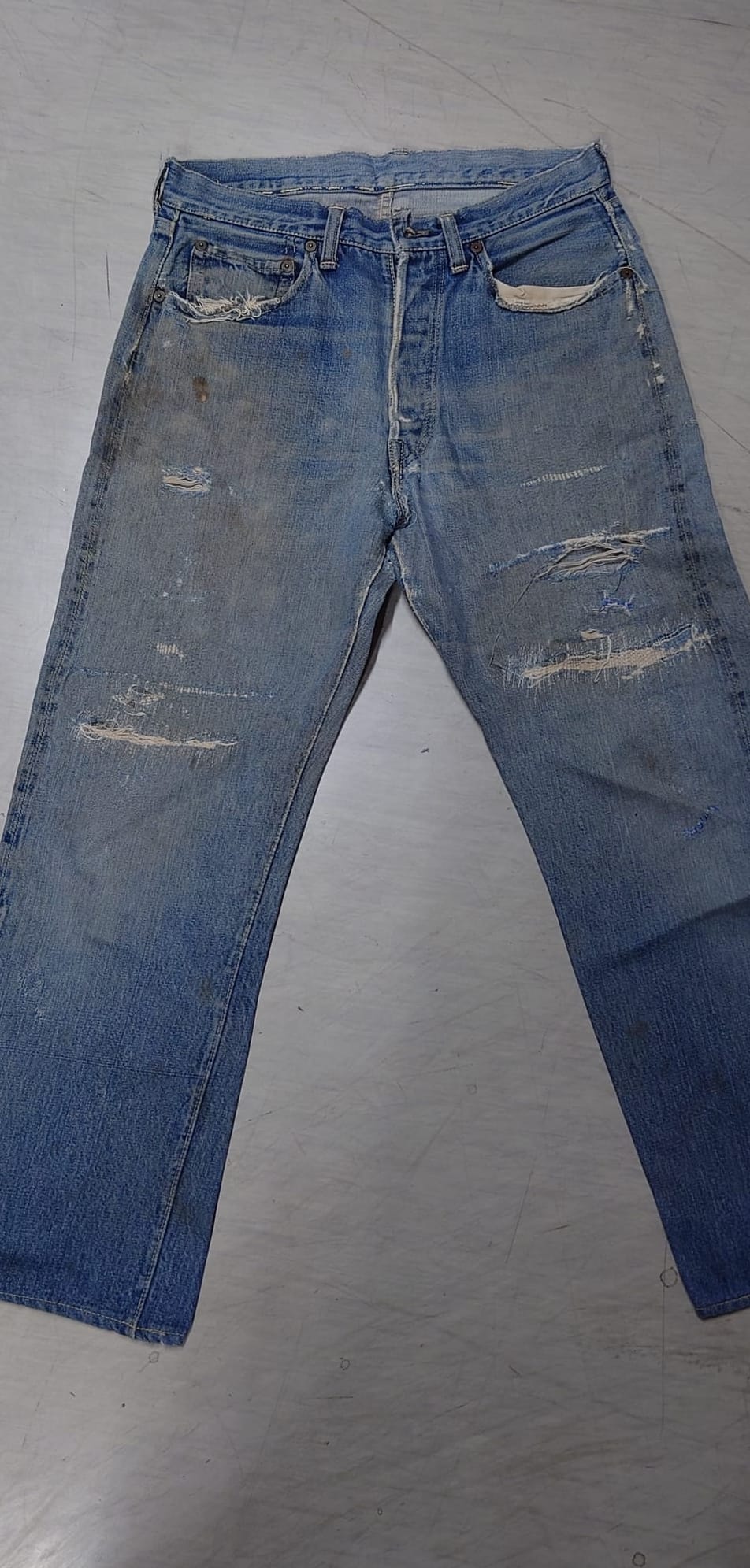
A pair from our own collection, photographed flat. Years of wear have left deep overall fading, horizontal tears, and scattered paint marks across the whole garment. The longer a pair is worn, the more the time accumulates as fade, rips, and stains over the entire piece — this is "how long and how, inscribed into the cloth" made visible. (Editorial photo)
Wash philosophy. Someone who washes every two weeks and someone who washes every six months will produce very different garments from the same starting point. High wash frequency tends toward smoother, more even lightening. Low frequency, high-wear approaches — the style that produces the dramatic "samurai fades" admired in vintage Levi's Big E examples — let the body's specific stress patterns concentrate before any wash intervention.
Why No Two Fades Are Identical
The impossibility of replication comes from two sources compounding each other.
The first is wearer individuality. Even if you could control for body type, two people's movement habits are never identical. Gait, posture, occupation, commute, how they sit on a barstool — all of it is individual, and all of it leaves a trace.
The second is fabric individuality. Even within a single production run, yarn irregularities, slight variations in dyeing depth, and subtle weave tensions mean that nominally identical pairs will have different fade potential. This was more pronounced in vintage production — a pair of 1960s Levi's 501s pulled from deadstock will have visible yarn character that modern mass production has largely flattened out. Selvedge denim from shuttle looms retains more of this character than modern open-end spun fabric, which is part of why the selvedge community assigns so much significance to these variations.
The wearer's individuality and the fabric's individuality interact. The result is a fade that cannot be duplicated, because both inputs are unrepeatable.
Reading Fade as an Act of Imagination
When you look at a heavily worn pair of jeans — your own or someone else's — and feel compelled to read them, what are you actually doing?
You're reconstructing a body in motion. The whisker angles suggest how someone's hips moved through thousands of steps. The honeycombs tell you how a knee bent, repeatedly, under load. The seat fade tells you something about how many hours were spent sitting, and in what kind of chair. This isn't forensic certainty — you can't reconstruct a biography from a pair of jeans. But you're not doing nothing, either.
Vintage denim collectors know this experience well. Part of the appeal of hunting for a strong original pair — a worn 501 Big E, a beat-up pair of 1960s Wranglers with rodeo wear, a Lee 101 that shows serious ranch use — is the interpretive act the garment invites. Who wore this? What did their days look like? The fade pattern is a set of clues, and the act of reading them is a form of historical imagination.
This dynamic doesn't require vintage provenance. Even a contemporary pair of raws that you've been wearing for two years carries the same charge — you can look at your own whiskers and remember the job you had, the bike commute you took, the trip where you wore them every day for three weeks. The fade is an index of elapsed life.
If a photograph records a moment — a single frame extracted from time — then denim fade records duration. It's an accumulation rather than a capture. The photograph says "this is what existed at this instant." The worn pair of jeans says "this is what moving through time, in this body, doing these things, felt like."
Four-Point Summary
Let's bring the threads together.
-
Indigo's surface structure makes fade directional. The shin-shiro (white core) construction means friction reveals contrast rather than simply removing color uniformly. Stress patterns become visible patterns.
-
The fabric records what can't be quantified. Body geometry, movement habits, the texture of daily activity, wash philosophy — none of this is numerical, but all of it gets inscribed. The denim encodes the quality of time, not just the quantity.
-
Replication is structurally impossible. Fabric individuality and wearer individuality compound each other. The same model of jeans, worn by the same person for the same duration, will produce a different result if the specific fabric differs. The intersection of two unrepeatable inputs guarantees an unrepeatable output.
-
Reading fade is an imaginative act. Whether you're studying your own wear patterns or examining a stranger's vintage find, the act of reading fade involves projecting a body and a life behind the physical evidence. It's not forensics — it's historical imagination with textile evidence.
The language that surrounds denim — "break in," "develop," "earn your fade" — isn't accidental. It reflects an intuition that's been circulating in denim culture since at least the 1990s vintage revival: that a worn pair of jeans is not a degraded version of a new pair but a more specific one. It has become something that only the intersection of this fabric and this person and this span of time could have produced.
Science can explain every step of how that happens. But science can't make it happen the same way twice.
Denim is a garment you can explain with chemistry — but chemistry alone can't explain why no two pairs ever look the same.
Sources & References
- Burgess, G. & others. Indigo Dyeing: Surface Adhesion and Fiber Penetration in Vat Dye Systems. Textile Research Journal, general reference.
- Lynn, G. The Levi's Guides: Understanding Vintage Denim Construction. Various archival interviews and collector documentation, 1990s–2010s.
- Cone Mills White Oak Plant historical documentation and production records (public), 1905–2017.
- r/rawdenim community wiki: "Fade Friday" archive and accumulated wearer documentation, 2010–present.
- Vintage Denim by Emma McClendon, Fashion Institute of Technology (MFIT) catalogue, 2014.
- General textile science references on ring-spinning, rope dyeing, and shuttle-loom construction as documented in public industry sources.
Share this article
Related Articles
- Culture & SubcultureWhy We Love Worn-In Over Brand New — The Aesthetics of Imperfection in DenimA crisp new pair straight off the shelf, or a pair with six months of honest fades already sunk in? …
- Culture & SubcultureWhen the Armor Comes Off — Reading Denim in *The Wolf of Wall Street*Jordan Belfort in a suit is a weapon. Jordan Belfort in jeans is just a man. Scorsese's 2013 film ac…
- Culture & SubcultureThe Myth Machine Behind WWII Denim — Legend, Reality, and the "War Model" MystiqueCollectors call them War Models — the stripped-down 501XXs born of wartime rationing. But how did a …
- Culture & SubcultureWhy Vintage Denim Looks Better Than New — The Psychology of Worn-In ClothesYou've picked up a pair of beat-up 501s at a thrift shop and felt more pull than anything hanging on…
- Culture & SubcultureSteinbeck's The Grapes of Wrath — What Denim Meant Before It Meant RebellionBefore James Dean made the 501 a symbol of defiance, the Joad family wore denim because it was all t…
Go Deeper
For the deeper cultural history behind color, memory, and how blue in particular has carried meaning across centuries, this is the definitive account.
📖 Find it on Amazon
As an Amazon Associate we earn from qualifying purchases.
Related Articles
Articles in the same category:
- Denim Honeycomb Fade Explained: 3-Stage Formation Process & 4 Tips to Deepen the Crease Pattern
- Denim Atari Fade Patterns Explained: Tate-Ochi, Yoko-Ochi, Dan-Ochi & Marble — 4 Types Compared
- How Often Should You Wash Raw Denim — The Monthly / 3-Month / 6-Month / Never Debate
- How to Choose the Right Detergent for Raw Denim — Neutral, Mild-Alkaline & Specialist Options
Go Deeper — Books and Films
A few books and films that sit alongside this article — denim and American culture, read and watched.
- Rebel Without a Cause (1955)
James Dean made denim the uniform of teenage rebellion. The starting point for everything that came after. - The Wild One (1953)
Marlon Brando and the motorcycle jacket. The film that built the biker-and-denim archetype. - Easy Rider (1969)
The American New Cinema landmark. Freedom, the open road, and denim as a way of life.
This site uses affiliate links. Purchases made through these links support NJNL at no extra cost to you.