Denim Repair — The Culture of Mending, from Boro Rags to Sashiko Stitching
Care & Washing · 2026-06-19 · ~1,900 words · ~8 min read
Contents (7)
- Two Kinds of Damage — and Why the Difference Matters
- Boro — Japan Did This Before Denim Was Invented
- Sashiko and Darning — The Two Techniques Worth Knowing
- How Much Can You Do Yourself?
- Tools
- Repair in the Context of the Fade
- Related Articles
Everyone in the raw denim world talks about the fade. The whiskers that lock in after the first hundred wears, the honeycombs behind the knee that only form if you actually live in the jeans, the vertical streak fades that tell you something about the loom that wove the cloth. The language around raw denim is almost entirely about accumulation — what the denim collects over time.
Repair fits that same logic. If the point is to wear a pair long enough that it becomes a record of your movement, then a patch sewn into the crotch blow-out isn't an interruption of that record. It is the record. The Japanese had figured this out centuries before denim existed.
Two Kinds of Damage — and Why the Difference Matters
Before getting into technique, it helps to be precise about what kind of damage you're actually dealing with. There are two distinct failure modes in denim:
The first is fraying. This is gradual fiber death from repeated friction — inner thighs, knees, the hem dragging on pavement, pocket openings that get pulled a thousand times. The indigo surface wears away first, then the warp and weft threads begin to snap individually. What looks like "good fading" at week forty can be the leading edge of a blowout by month eight if you don't catch it.
The second is acute hole damage — either the end stage of fraying, or a sudden tear from snagging on something. The mechanism matters because it changes how you approach the repair. Fraying tends to weaken a broad area around the visible damage, meaning any repair needs to address the surrounding tissue, not just the hole. Acute tears may have relatively healthy fabric immediately adjacent.
Both types share one critical characteristic: they get worse if ignored. Once threads start snapping, load redistributes to the survivors, and the cascade accelerates. Early intervention is almost always easier and more durable than late-stage rescue.
Boro — Japan Did This Before Denim Was Invented
Somewhere around the Edo period (1603–1868), in the colder agricultural and fishing regions of northern Japan, a textile tradition emerged that rawheads would recognize immediately if you described it in denim terms: wear something until it blows out, patch it, wear it more, patch it again, repeat across generations.
The result was called boro — literally derived from the Japanese word for rags or tatters. Peasant farmers under the Tokugawa shogunate were legally barred from wearing silk; their clothing came from hand-grown, hand-spun, hand-woven hemp and cotton. Fabric was so scarce that nothing was discarded. When a garment wore through, new cloth was layered over the damage and stitched down. When that patch wore through, another went on top. A single garment might accumulate the labor of three or four generations of a family.
Two details matter for the denim context. First, a large proportion of surviving boro is indigo-dyed. Indigo (specifically the compound indigotin, derived from Polygonum tinctorium in Japan) was the most accessible dye for rural communities, and it carried a practical reputation for insect resistance that made it the default for workwear. Second — and this is the key cultural point — boro wasn't considered beautiful at the time. It was poverty made visible. The reassessment came later, through the mingei (folk craft) movement of the twentieth century, and boro pieces are now held in serious museum collections.
The parallel to a beat-to-hell pair of Levi's 501s that someone's been wearing for six years isn't accidental. Both objects encode the same logic: use value extended through repeated repair, with the repair history becoming inseparable from the object itself. The difference is that boro did this out of necessity; raw denim does it by choice. That choice carries its own weight.
Sashiko and Darning — The Two Techniques Worth Knowing
Sashiko
Sashiko (刺し子, roughly "little stabs") is a Japanese hand-stitching technique that predates Western denim by centuries. The classic form uses white cotton thread on indigo-dyed cloth, worked in continuous geometric patterns — running stitches that build up into grids, diamonds, waves, or interlocking hexagons depending on the regional tradition.
The origin is practical, not decorative. Fishing and farming garments needed reinforcement at stress points, and sashiko stitching adds structural density without adding bulk. The pattern isn't ornamental in origin — it's load distribution made systematic. The fact that it's also visually striking is a byproduct of the geometry required to cover the surface efficiently.
For denim repair, sashiko offers something specific: it treats a zone rather than just a point. Instead of patching only the hole, you work outward into the surrounding fabric, reinforcing the tissue that's been weakened by whatever caused the hole in the first place. The standard stitch ratio in traditional sashiko — longer stitches on the visible face, shorter on the back, approximately 3:2 — ensures the surface that takes wear has more thread coverage.
The aesthetic of sashiko repair is also deliberately non-concealing. White thread on indigo denim is high-contrast; it announces the repair rather than hiding it. This isn't a workaround — it's the point. The mend is part of the object's story, and sashiko makes it legible.
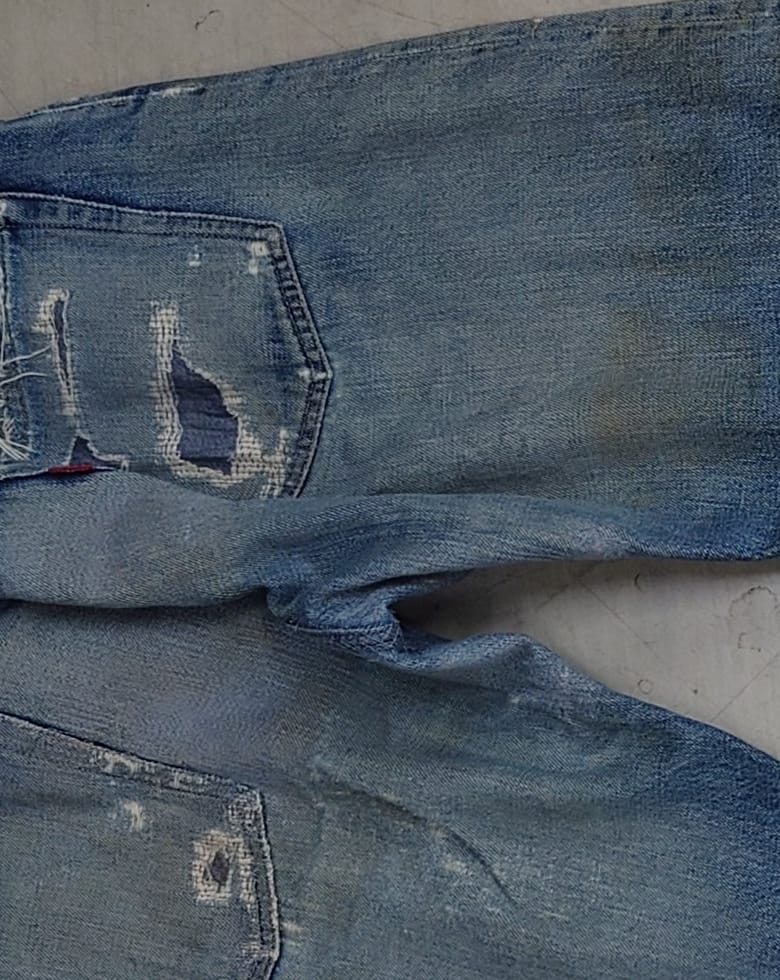
The back pocket of a pair our editor wore for years. A backing cloth sits behind the torn area, held down with sashiko stitching worked as a field rather than a single line. The white stitches deliberately show the mend instead of hiding it — exactly the "make the repair legible" aesthetic described above. (Real pair, photographed by the editor.)
Darning
Darning is the European equivalent, and the technique is structurally different. Where sashiko works across a surface, darning reconstructs fabric: you lay parallel warp threads across a hole, then weave weft threads over and under them, effectively re-weaving the missing cloth from scratch. The classic application is sock heels and elbows, but it works on denim with some adjustments for thread weight.
For smaller holes and thin spots, darning has a lower barrier to entry than sashiko — the motion is simple, the tools minimal. The challenge on denim is matching thread weight and keeping the tension consistent enough that the repaired area doesn't pucker when the fabric relaxes.
Darning has had a significant cultural moment in the last decade under the name visible mending — a philosophy that treats repair as design rather than concealment. On indigo denim specifically, high-contrast darning (white or natural thread against dark fabric, or even colored thread as deliberate contrast) reads as intentional rather than apologetic. The rawdenim community's existing comfort with wearing visible wear history makes this framing land naturally.
A darning mushroom — a wooden form that holds the fabric taut while you work — isn't strictly necessary, but it meaningfully improves results. Working against a smooth, rounded surface keeps the fabric at consistent tension, which reduces puckering in the finished repair.
How Much Can You Do Yourself?
Honest assessment of scope is more useful than optimism here. The table below reflects what's genuinely achievable for someone with basic hand-sewing ability:
| Situation | Recommendation |
|---|---|
| Early fraying, no hole yet | DIY sashiko or darning — this is the ideal intervention point |
| Clean hole, 2–3 cm or smaller | DIY with darning or sashiko, with backing fabric for stability |
| Large hole, 5 cm+, especially crotch area | Professional repair strongly recommended |
| Seam failure, chain-stitch blowout | Requires industrial sewing machine — find a specialist |
| Vintage denim, any damage | Assess surrounding fabric strength first; if in doubt, professional |
The vintage caveat deserves elaboration. A pair of 1960s Levi's 501s or a Wrangler 11MWZ from the same era may look repairable, but decades-old cotton that's been through repeated wash cycles has often lost significant tensile strength across the whole garment, not just at the damage site. Applying stress to one area via repair — particularly with a sewing machine — can trigger cascade failures in adjacent fabric. If the denim is worth anything historically or monetarily, consult a specialist who can assess overall fabric health before touching it.
For contemporary raw denim in the 12–14 oz range that's simply been worn hard, the DIY window is genuinely wide.
Tools
The minimum viable kit is a needle and thread. Everything else is optimization.
Sashiko needle: Longer and heavier than a standard hand-sewing needle, with a larger eye. Designed to carry thick sashiko thread through multiple layers of cloth without bending. Worth getting the right tool.
Sashiko thread: 100% cotton, single-ply, consistent twist. The standard Japanese sashiko thread is noticeably chunkier than embroidery floss and produces the characteristic textured surface. For a less visible repair on indigo denim, a medium-blue cotton thread in similar weight works well. For the full visible-mending aesthetic, white is traditional.
Backing fabric: For hole repair (as opposed to surface reinforcement of intact fabric), you need something behind the hole to anchor your stitching. A scrap of similar-weight denim, selvedge trim, or purpose-made iron-on repair cloth all work. The backing supports the new stitching and distributes load.
Darning mushroom: Optional but useful. If you're doing darning rather than sashiko, the mushroom keeps the fabric taut and the working surface consistent. A lightbulb works in a pinch.
Thread color: The choice between matching and contrasting thread is genuinely a philosophy question, not just an aesthetic one. Matching navy thread on indigo denim reads as an attempt to erase the repair. White sashiko thread reads as an honest acknowledgment of it. There's no wrong answer, but it's worth deciding intentionally.
Repair in the Context of the Fade
Raw denim culture has always been comfortable with the idea that wear leaves marks — that's the whole point. The whiskers at the hip crease, the honeycombs behind the knee, the fading on the thigh face: all of these are valued precisely because they're specific to a body moving through a particular life.
Repair fits this framework completely. A crotch blown out after three years of daily wear tells you something. The sashiko grid that fills it in — worked by hand, stitched carefully, visible for the rest of the garment's life — tells you something else, and the two things together tell you more than either alone.
Boro developed the same logic under radically different economic conditions: not as a philosophy of wear, but as a practice of survival. The aesthetic appreciation came later. With raw denim, the aesthetic appreciation comes first, but the underlying logic — that an object's repairs are part of its meaning — is the same across four hundred years.
If you've got a pair sitting in a drawer because the crotch blew out, the barrier to starting is lower than it probably feels. A needle, some thread, an hour. The result won't look new. It'll look like what it is: something worth keeping.
Sources & References
- Yanagi, Sōetsu. The Unknown Craftsman: A Japanese Insight into Beauty. Kodansha International, 1972. (Foundational text on mingei and the folk object aesthetic that rehabilitated boro)
- Heddels. "The History of Sashiko." Heddels.com, 2018. (Overview of sashiko origins and denim application)
- Nihon Mingeikan (Japan Folk Crafts Museum), Tokyo — public collection documentation on boro textiles
- Vogue Knitting / Tilly and the Buttons: Visible Mending technique documentation (general textile darning methodology)
- Sandberg, Gösta. Indigo Textiles: Technique and History. Lark Books, 1989. (Indigo dyeing history across cultures, including Japanese tsutsugaki and katazome traditions)
- Long, Kim. "Boro: The Fabric of Life." Selvedge Magazine, Issue 72. (Museum-quality boro documentation and cultural context)
Share this article
Related Articles
- Care & WashingHow to Fix Denim Knee Blowout — Darning, Backing Fabric, Patches & Pro Repair ComparedKnee blowout is an inevitable milestone in serious raw denim wear. This piece compares four repair a…
- Care & WashingWhy Fabric Softener Suppresses Raw Denim Fade — The Quat Film ExplainedFabric softener's active ingredient — a cationic quat surfactant — forms a lubricating film on cotto…
- Care & WashingRaw Denim First Wash: Calculating Shrinkage (3–10%) and Indigo Loss Before You StartUnsanforized raw denim shrinks 3–10% — but warp and weft shrink at different rates and require separ…
- Care & WashingDenim Storage Done Right — Hang vs. Fold, Long-Term Care & Indigo Fade PreventionYour jeans are changing even when you're not wearing them. Light, gravity, humidity, and fold pressu…
- Care & WashingHow Often Should You Wash Raw Denim? Monthly vs. 3-Month vs. Never — Science-Backed GuideMonthly, every three months, twice a year, or never? The raw denim community has been arguing about …
Related Articles
Articles in the same category:
- Denim Honeycomb Fade Explained: 3-Stage Formation Process & 4 Tips to Deepen the Crease Pattern
- Denim Atari Fade Patterns Explained: Tate-Ochi, Yoko-Ochi, Dan-Ochi & Marble — 4 Types Compared
- How Often Should You Wash Raw Denim — The Monthly / 3-Month / 6-Month / Never Debate
- How to Choose the Right Detergent for Raw Denim — Neutral, Mild-Alkaline & Specialist Options
Go Deeper — Books and Films
A few books and films that sit alongside this article — denim and American culture, read and watched.
- Rebel Without a Cause (1955)
James Dean made denim the uniform of teenage rebellion. The starting point for everything that came after. - The Wild One (1953)
Marlon Brando and the motorcycle jacket. The film that built the biker-and-denim archetype. - Easy Rider (1969)
The American New Cinema landmark. Freedom, the open road, and denim as a way of life.
This site uses affiliate links. Purchases made through these links support NJNL at no extra cost to you.