What Are We Actually Seeing When We Say Denim Has "Character"? — Dissecting the Language of Fade
Denim & Psychology · 2026-06-03 · ~1,800 words · ~8 min read
Contents (6)
- Why "Character" Is Genuinely Hard to Define
- Four Candidates for What "Character" Actually Means
- The Conditions Under Which "Character" Works as an Evaluation
- Where Character Ends and "Just Wrecked" Begins
- What the Word Reveals About Values
- Related Articles
Anyone who has spent time on raw denim forums has encountered some version of this moment: someone posts a pair of heavily worn Levi's 501s or a beat-up pair of selvedge jeans, and the comments fill with words like character, patina, or the shorthand verdict — these have it. Everyone seems to agree. But ask those same people to define precisely what "it" is, and the conversation gets murky fast.
This is worth examining seriously. "Character" and "patina" function as evaluative terms in denim culture — they signal approval, quality of wear, authenticity. They do real communicative work. So what exactly are they pointing at?
Why "Character" Is Genuinely Hard to Define
Words like character belong to a category philosophers of language sometimes call thick evaluative terms — they combine descriptive content with an evaluative charge, but they resist being fully reduced to either. "Sweet" has a physical correlate: sugar molecules on taste receptors. "Beautiful" is more culturally variable but still anchors to perceptual experience in a fairly stable way across communities.
"Character" in the denim sense does neither cleanly. It gestures at something visible — you can point to a pair of jeans and say there — but the thing being pointed at is not a single measurable property. It's a gestalt.
And yet the word functions. Within the raw denim community — on forums, in brand copy from Levi's Vintage Clothing to independent Japanese producers, in the comment sections of fade contest threads — "character" carries shared meaning. People broadly agree on which pairs have it and which don't. That consensus suggests the word is tracking something real, even if articulating it precisely is difficult.
So what is it tracking?
Four Candidates for What "Character" Actually Means
Looking at how the term gets used — which jeans attract it, which don't, what gets said alongside it — a few distinct things seem to be in play.
Candidate A: Complexity of wear patterns
A single, uniform fade is rarely described as having character. What tends to attract the word is a layering of multiple distinct wear patterns on the same piece of fabric. Whiskers at the hips, honeycombs behind the knees, vertical stack fades down the leg, blown-out areas at the seat or thigh — when several of these distinct fade types coexist on one pair of jeans, the visual information density goes up dramatically. There's a lot to read.
This is part of why jeans woven from high-quality selvedge denim — the kind with enough structural integrity to hold crisp, defined fade lines over months or years — tend to score higher on character evaluations than heavily processed fast-fashion denim, which tends to fade uniformly and lose definition quickly. The fabric's ability to hold contrast, to maintain distinct light and dark zones rather than blurring into a flat grey, is a precondition for this kind of complexity.
Cone Mills White Oak denim, before the mill closed in 2017, was prized partly for exactly this — its slubby, irregular weave created surfaces that could develop unusually pronounced and varied fade patterns. The grief at its closure was, among other things, grief about losing a particular kind of character-generating material.
Candidate B: Legibility of individual history
A second candidate: character is the legibility of a specific person's specific life in a garment. Levi's marketing has leaned on this for decades — the idea that your 501s tell your story, that wear is autobiography. There's something to it beyond marketing copy.
Industrially distressed jeans — sandblasted, enzyme-washed, artificially creased — are almost universally excluded from "character" evaluations by the raw denim community, even when they look superficially similar to heavily worn authentic pairs. The objection isn't purely aesthetic. It's that artificially distressed jeans are illegible as personal history. The marks don't mean anything about a particular person; they were put there by a machine to simulate meaning.
Authentically worn jeans, by contrast, are read as documents. The whisker placement reflects how a specific body sat and moved. The knee fades record how someone walked. This legibility — the sense that you're reading traces of an actual life — seems to be a significant component of what "character" is pointing at.
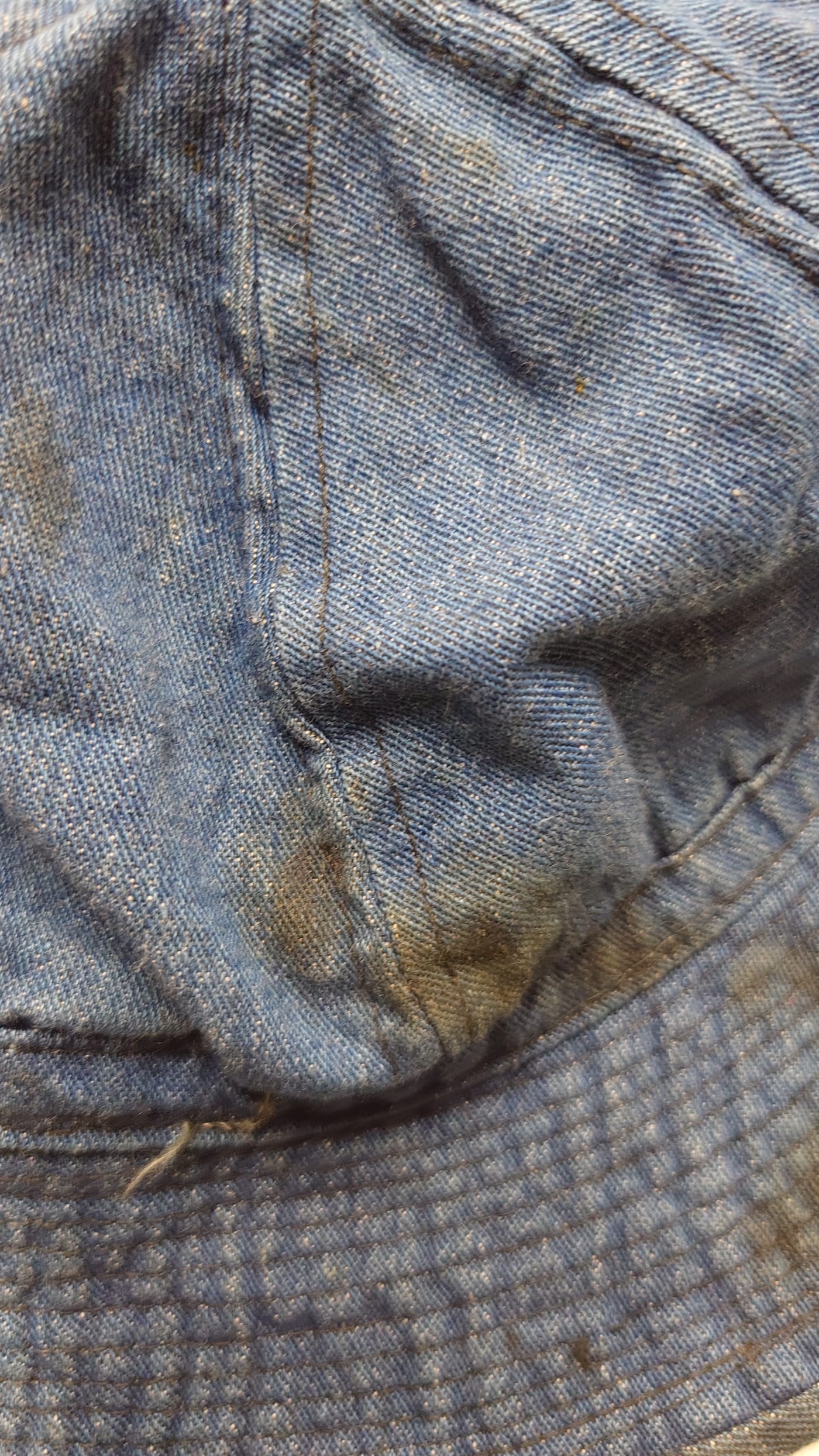
The crotch of a work pant from our own collection. Oil picked up on the job has soaked into the cloth, creating a one-of-a-kind state no mass-produced pair could have. This is what "reading a specific person's life in the garment" actually points at. (Editorial photo)
Candidate C: Visible accumulation of time
Character also seems to involve not just amount of change but the visible layering of change over time. A pair that faded dramatically in six months of heavy wear may have striking fades, but jeans worn steadily for two or three years often have something different: multiple generations of wear pattern overlaid on each other. New fades sit on top of older, softer fades. Recent abrasion marks contrast with long-established indigo loss.
This is what "depth" means in fade discussion — not just the degree of contrast between light and dark, but the visible stratigraphic record of change. You can almost date it. The phrase "earned fades" gestures at this; the implication is that the depth corresponds to actual time and wear, not acceleration.
This is also why jeans that have been worn by someone with very regular, consistent habits — a construction worker, a farmer, someone who sits the same way every day — often develop extraordinarily clean, defined patterns that get described as having exceptional character. The consistency of the behavior is legible in the consistency of the marks.
Candidate D: Productive incompletion
Fourth candidate, and perhaps the most counterintuitive: character seems to attach more readily to jeans that are still changing than to jeans that have reached a kind of terminal state. A pair worn past the point of structural integrity — threadbare, blown out, essentially destroyed — often stops attracting character language and starts attracting different vocabulary (destroyed, done, retired).
The sweet spot for character evaluation seems to be somewhere in the middle: enough wear to have accumulated complexity, not so much that the process has concluded. There's an aesthetic preference for becoming over completed, for jeans that still have somewhere to go.
The Conditions Under Which "Character" Works as an Evaluation
These four candidates — complexity, personal legibility, temporal depth, productive incompletion — don't operate independently. Character as an evaluative term seems to require several background conditions before it can function at all.
Shared premise about value and wear: "Character" only operates as a positive evaluation inside a community that shares the premise that wear adds value rather than subtracting it. Outside that community — to someone whose evaluative framework is based on condition, newness, or resale value in the conventional sense — the same pair of jeans just looks used. The word only lands if the listener already holds the underlying value premise.
This is worth noting because it means "character" is partially a tribal marker. Using it correctly signals membership in a particular evaluative community, not just a descriptive claim about a pair of jeans. When someone on a raw denim forum says a pair has character, they're simultaneously describing the jeans and identifying themselves as someone who knows how to read jeans.
Naturalness of the marks: The community consistently distinguishes between wear that happened through use and wear that was imposed artificially. This distinction underpins a lot of the contempt for heavy factory distressing. The marks have to be caused by the wearer's behavior; they can't be faked in. Jeans that look worn but weren't actually worn through use tend to fail the character evaluation even when the visual result is similar, because knowledgeable observers can often tell the difference — and even when they can't visually, the knowledge that the marks were artificial changes the evaluation.
Structural coherence: Character evaluations also seem sensitive to whether the wear pattern coheres as a whole. A pair of jeans where the fades look random, distributed without evident relationship to body movement and posture, tends to score lower than one where the wear pattern has an internal logic — where the marks make sense given how jeans and bodies interact. This is part of what separates "character" from "damage."
Where Character Ends and "Just Wrecked" Begins
The boundary between has character and just destroyed is probably the sharpest test of what the term means.
In practice, the distinction seems to track a few things: whether the fabric still has structural integrity; whether the marks remain readable as purposeful use rather than neglect; and whether there's a sense that the wear was managed — that someone paid attention to these jeans, cared about them, made decisions about washing and wearing and rotating that resulted in this particular state.
Jeans that were simply neglected — worn until they fell apart without any apparent attention to their development — tend not to attract character language even if they look heavily faded. There's a sense that character requires some degree of intentionality, even if that intentionality is mostly just consistent, attentive wearing rather than deliberate engineering.
This is also why the same visual outcome can attract completely different evaluations depending on what the viewer knows or infers about the history. Levi's LVC reproductions worn with conscious attention to their development read differently than identical-looking jeans found at a thrift store with unknown provenance, even if the fades are objectively similar.
What the Word Reveals About Values
Pulling this together: "character" in denim culture appears to function as a compressed evaluation of several overlapping things — the complexity of wear patterns, the legibility of individual history, the visible accumulation of time, and the sense that the jeans are still in productive transformation. None of these alone seems sufficient. It's when they stack that the word clicks into place.
But there's a second-order observation worth making. Unpacking "character" this carefully reveals something about the value system underneath raw denim culture more broadly. The things "character" rewards — individual history, patient accumulation, authentic process, attentive stewardship — are a specific set of values. They are values that push against disposability, speed, and mass uniformity.
This is presumably not an accident. Raw denim culture emerged partly as a reaction against the fast-fashion logic that made jeans interchangeable and short-lived. "Character" is the evaluative vocabulary that gives that reaction its positive content — not just against disposability, but for something specific: the visible record of a life lived in clothing that was made to last and worn with attention.
Denim, as someone once put it, can be fully explained by science. But science alone won't make two pairs look the same.
Sources & References
- Levi Strauss & Co. historical archives and LVC product documentation (public-facing)
- Cone Mills White Oak selvedge denim production records and community retrospectives (various denim forums, 2017–2019)
- Long-form fade documentation threads, r/rawdenim (Reddit), selected threads 2015–2025
- Walton, Kendall. "Categories of Art." The Philosophical Review, 1970 — on the role of category context in aesthetic evaluation
- General public literature on textile aging, indigo dye behavior, and yarn construction from denim trade publications
- Community-sourced fade contest archives and evaluative commentary (Self Edge, BiG, various)
Share this article
Related Articles
- Culture & SubcultureWhy We Love Worn-In Over Brand New — The Aesthetics of Imperfection in DenimA crisp new pair straight off the shelf, or a pair with six months of honest fades already sunk in? …
- Culture & SubcultureWhen the Armor Comes Off — Reading Denim in *The Wolf of Wall Street*Jordan Belfort in a suit is a weapon. Jordan Belfort in jeans is just a man. Scorsese's 2013 film ac…
- Culture & SubcultureThe Myth Machine Behind WWII Denim — Legend, Reality, and the "War Model" MystiqueCollectors call them War Models — the stripped-down 501XXs born of wartime rationing. But how did a …
- Culture & SubcultureWhy Vintage Denim Looks Better Than New — The Psychology of Worn-In ClothesYou've picked up a pair of beat-up 501s at a thrift shop and felt more pull than anything hanging on…
- Culture & SubcultureSteinbeck's The Grapes of Wrath — What Denim Meant Before It Meant RebellionBefore James Dean made the 501 a symbol of defiance, the Joad family wore denim because it was all t…
Go Deeper
This is the book this article's argument leans on hardest: an authoritative look at what selvedge culture and fade actually mean to the people who obsess over them.
📖 Find it on Amazon
As an Amazon Associate we earn from qualifying purchases.
Related Articles
Articles in the same category:
- Denim Honeycomb Fade Explained: 3-Stage Formation Process & 4 Tips to Deepen the Crease Pattern
- Denim Atari Fade Patterns Explained: Tate-Ochi, Yoko-Ochi, Dan-Ochi & Marble — 4 Types Compared
- How Often Should You Wash Raw Denim — The Monthly / 3-Month / 6-Month / Never Debate
- How to Choose the Right Detergent for Raw Denim — Neutral, Mild-Alkaline & Specialist Options
Go Deeper — Books and Films
A few books and films that sit alongside this article — denim and American culture, read and watched.
- Rebel Without a Cause (1955)
James Dean made denim the uniform of teenage rebellion. The starting point for everything that came after. - The Wild One (1953)
Marlon Brando and the motorcycle jacket. The film that built the biker-and-denim archetype. - Easy Rider (1969)
The American New Cinema landmark. Freedom, the open road, and denim as a way of life.
This site uses affiliate links. Purchases made through these links support NJNL at no extra cost to you.